
|
Getting your Trinity Audio player ready...
|
- Florida Senate unanimously passed Bill 314, creating the first detailed U.S. framework for stablecoin regulation.
- Stablecoin issuers must hold 1:1 reserves, follow KYC rules, and report large transactions.
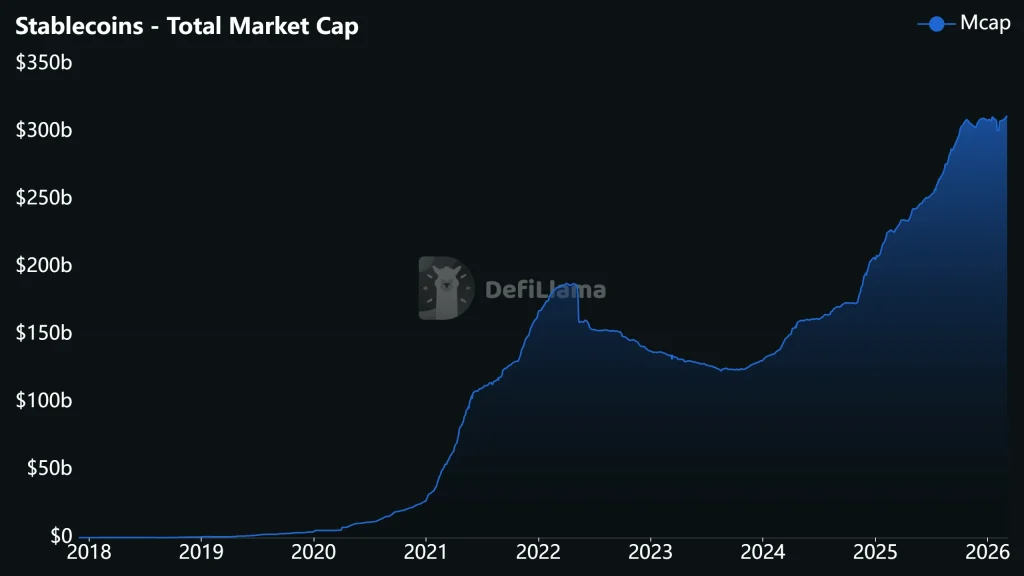
- The global stablecoin market has surged to over $312 billion as adoption accelerates.
Florida has taken a significant step toward regulating the fast-growing stablecoin sector. On March 6, the state Senate unanimously approved Bill 314, a sweeping piece of legislation that outlines rules for payment stablecoins. If signed by Governor Ron DeSantis, Florida would become the first U.S. state to implement a comprehensive regulatory framework specifically designed for stablecoins.
The move highlights the state’s increasingly pro-crypto stance and comes as lawmakers across the country debate how digital dollar tokens should be supervised. Florida’s approach closely mirrors the proposed federal GENIUS Act, aiming to ensure the state’s rules align with potential nationwide standards.
Stablecoins Classified as Payment Instruments, Not Securities
A key element of Bill 314 is its legal classification of stablecoins. The legislation states that stablecoins should not be treated as securities. Instead, companies issuing them will be regulated as Money Services Businesses (MSBs), similar to how certain financial service providers operate.
This classification aligns Florida with regulatory approaches already seen in states like Texas and New York. Under the new framework, stablecoin issuers must obtain proper licenses, including a state MSB license or other regulatory approvals.
The bill also imposes strict compliance requirements. Issuers must implement anti-money laundering safeguards, conduct Know Your Customer (KYC) verification, and maintain real-time transaction records comparable to those used in traditional banking.
Additionally, transactions exceeding $10,000 must be reported to regulators, while suspicious activity must be flagged to the Florida Office of Financial Regulation.
Reserve Requirements and Federal Oversight Threshold
To protect users and maintain confidence in stablecoins, the legislation requires issuers to maintain a full 1:1 reserve backing their tokens. This means every stablecoin in circulation must be supported by equivalent assets.
The bill also introduces a scale-based regulatory transition. Once a stablecoin’s total valuation surpasses $10 billion, oversight would shift toward federal supervision.
Lawmakers say this approach ensures that smaller projects can innovate at the state level while large issuers eventually fall under national regulatory scrutiny.
Debate Over Stablecoin Yields Continues
Another unresolved issue in the legislation involves whether stablecoin issuers can offer interest to token holders.
The Florida bill states that issuers cannot provide interest payments if federal law prohibits such practices. That decision effectively leaves the final determination to Congress, where lawmakers continue to debate stablecoin yield policies.
The discussion has drawn political attention. Critics argue that banks have lobbied against yield-bearing stablecoins due to concerns about funds leaving traditional deposits.
The legislation arrives as stablecoins grow rapidly in both adoption and market size. The global stablecoin market has climbed to roughly $312.85 billion, according to industry data, up sharply from about $205 billion in early 2025.
Major players continue expanding their ecosystems. Tether recently joined a $7.5 million funding round aimed at building APIs to enable payments using Tether on the Bitcoin network. Meanwhile, Circle’s USD Coin is now serving as liquidity backing for a new stablecoin ecosystem on the Cardano blockchain.
Also Read: Cypto Influencer Ben Armstrong (BitBoy) Arrested in Florida – Here’s What Happened
Florida’s stablecoin legislation signals growing momentum toward clearer digital asset regulation in the United States. By defining stablecoins, establishing compliance requirements, and aligning with potential federal standards, the state is positioning itself at the forefront of crypto policy.
If signed into law, the framework could serve as a blueprint for other states—and potentially federal lawmakers—as the stablecoin industry continues to expand.
Disclaimer: The information in this article is for general purposes only and does not constitute financial advice. The author’s views are personal and may not reflect the views of Chain Affairs. Before making any investment decisions, you should always conduct your own research. Chain Affairs is not responsible for any financial losses.

I’m a crypto enthusiast with a background in finance. I’m fascinated by the potential of crypto to disrupt traditional financial systems. I’m always on the lookout for new and innovative projects in the space. I believe that crypto has the potential to create a more equitable and inclusive financial system.