|
Getting your Trinity Audio player ready...
|
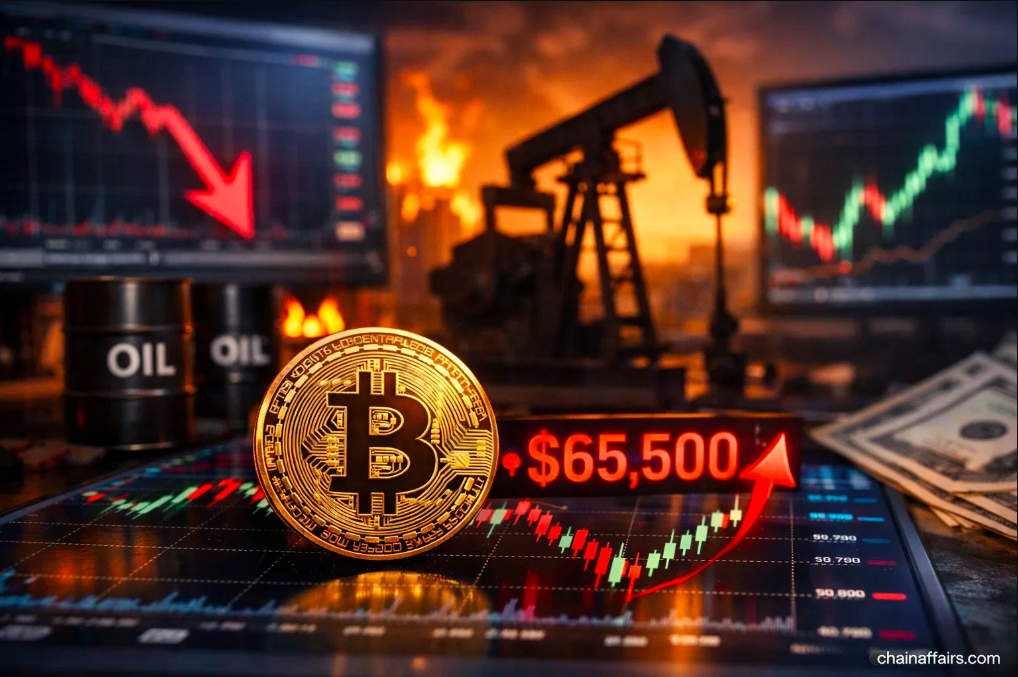
- Bitcoin dropped to $65,500 but quickly recovered above $67,500 as buyers stepped in.
- A spike in Brent crude oil triggered global risk-off sentiment across markets.
- Key levels to watch are $64K support and $68K resistance ahead of major inflation data.
Bitcoin briefly slipped to a one-week low early Monday as global markets turned cautious, but buyers quickly stepped in, pushing prices back above $67,500 within hours.
The world’s largest cryptocurrency fell about 2% during early Asian trading, touching roughly $65,500 as a surge in oil prices triggered a broad risk-off sentiment across financial markets. However, compared with sharp losses in equities across Asia, Bitcoin’s pullback remained relatively contained, signaling underlying resilience in the market.
Oil Surge Triggers Risk-Off Sentiment
The immediate catalyst behind the move was a spike in Brent Crude Oil, which climbed to around $120 per barrel for the first time since mid-2022. When oil prices rise rapidly, inflation concerns typically follow, prompting investors to scale back exposure to higher-risk assets.
In such environments, cryptocurrencies often experience heavy selling pressure. Yet Monday’s modest drop stood in contrast to steeper declines in equity markets like the Nasdaq Composite and KOSPI, which faced larger selloffs during the same period.
The relatively mild decline suggests Bitcoin may be holding up better than expected despite macroeconomic headwinds.
Lower Leverage May Be Supporting Bitcoin
Another factor helping stabilize prices is the apparent absence of excessive leverage in the market.
During previous downturns, large numbers of leveraged long positions—trades placed with borrowed money—often triggered cascading liquidations when prices fell. Those forced sales typically accelerated declines and deepened market volatility.
This time, however, analysts note that many speculative positions appear to have already been flushed out in earlier corrections. With fewer leveraged traders in the market, there is less risk of a chain reaction of forced selling.
As a result, the current holder base appears to consist largely of investors using their own capital, which historically leads to more patient market behavior.
Key Bitcoin Price Levels to Watch
Despite the quick rebound, traders are closely monitoring key technical levels that could shape Bitcoin’s next move.
The first major support sits around $64,000. If the price breaks decisively below that zone, the next potential floor could emerge near $61,000, where buying interest has previously stabilized the market.
On the upside, $68,000 remains the immediate resistance level. A strong move above that threshold could shift short-term momentum back in favor of bulls and potentially open the door for a broader recovery.
Inflation Data Could Drive the Next Move
Macro events later this week could play a decisive role in Bitcoin’s direction. Upcoming U.S. inflation reports—including February’s CPI and January’s PCE data—will be closely watched by investors.
With oil prices climbing, any signs of persistent inflation could pressure risk assets again and test Bitcoin’s support levels. Conversely, softer inflation data could restore confidence and help fuel another push higher.
Also Read: Crypto Liquidity Surge As USDC Drives Record $1.8T Stablecoin Activity
Bitcoin’s quick rebound after dipping to $65,500 highlights growing market stability despite rising macroeconomic uncertainty. While oil-driven inflation fears triggered a temporary selloff, the lack of excessive leverage and strong buyer interest suggest the market may be better positioned to absorb shocks than in previous cycles. With key inflation reports ahead, the coming days could determine whether Bitcoin breaks above resistance—or revisits critical support levels.
Disclaimer: The information in this article is for general purposes only and does not constitute financial advice. The author’s views are personal and may not reflect the views of Chain Affairs. Before making any investment decisions, you should always conduct your own research. Chain Affairs is not responsible for any financial losses.

I’m your translator between the financial Old World and the new frontier of crypto. After a career demystifying economics and markets, I enjoy elucidating crypto – from investment risks to earth-shaking potential. Let’s explore!