

|
Getting your Trinity Audio player ready...
|
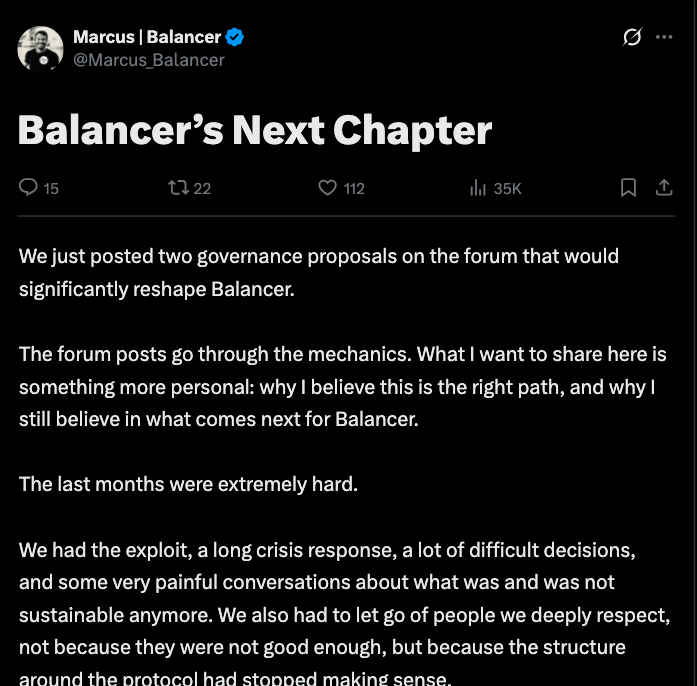
Balancer Labs, the team behind one of DeFi’s most established automated market maker protocols, is calling it quits — but the protocol itself may live on.
Founder Fernando Martinelli confirmed the decision this week, describing the company as a “liability rather than an asset” after months of operating without revenue. CEO Marcus Hardt added that the firm had been spending far more to attract liquidity than it was earning back — a strategy that steadily diluted holders of the BAL token.
A Protocol Laid Low by a Devastating Hack
Balancer’s decline tracks a familiar DeFi story: extraordinary highs followed by a brutal reality check. At its peak in November 2021, the protocol held $3.3 billion in total value locked (TVL). By October 2025, that figure had eroded to $800 million — and then a $116 million exploit that same month wiped out another $500 million in TVL within two weeks. Today, TVL sits at around $158 million.
The hack didn’t just hurt liquidity. It created what Martinelli called “real and ongoing legal exposure,” making it unsustainable to keep a corporate entity on the hook for unresolved security liabilities.
The Path Forward: DAO-Led, Leaner, and Restructured
Rather than a full shutdown of the protocol, Balancer’s leadership is pushing for a transition to a structure managed by the Balancer Foundation and its decentralized autonomous organization. The roadmap they’ve outlined is deliberately stripped back: cutting BAL token emissions to zero, restructuring fee mechanisms so the DAO captures more of the revenue, reducing team size, and targeting significantly lower operating costs.
Both Martinelli and Hardt have framed this not as a collapse, but as a necessary reset. DAO members are currently being asked to vote on two proposals covering operational changes and BAL’s tokenomics.
The Numbers Aren’t All Bad
What makes Balancer’s situation unusual — and arguably salvageable — is that the underlying protocol still functions. Over the past three months, it has generated over $1 million in revenue, a figure Martinelli highlighted as proof that the protocol works. The issue, he argued, isn’t the technology — it’s the economics built around it.
“The problem isn’t that Balancer doesn’t work,” Martinelli said. “The problem is that the economics around Balancer aren’t working. Those are fixable.”
Whether the DAO and Foundation can execute that fix remains to be seen. But unlike many DeFi post-mortems, Balancer is at least entering its next phase with a functioning product — and an honest accounting of what went wrong.
Also Read: $4.8M Crypto Blunder: South Korea Scrambles After Shocking Wallet Leak
Disclaimer: The information in this article is for general purposes only and does not constitute financial advice. The author’s views are personal and may not reflect the views of Chain Affairs. Before making any investment decisions, you should always conduct your own research. Chain Affairs is not responsible for any financial losses.