

|
Getting your Trinity Audio player ready...
|
- ASTER’s $0.70 support could determine its short-term trend.
- Momentum indicators suggest consolidation, not panic selling.
- Treasury liquidity may be the strongest predictor of Bitcoin’s next cycle.
Crypto markets are entering a period of uncertainty, with short-term technical tension in altcoins like ASTER colliding with longer-term macro signals influencing Bitcoin. While ASTER traders focus on a critical support zone, a new liquidity study suggests the next major crypto cycle may depend less on central bank policy and more on fiscal flows.
ASTER Faces Make-or-Break Technical Moment
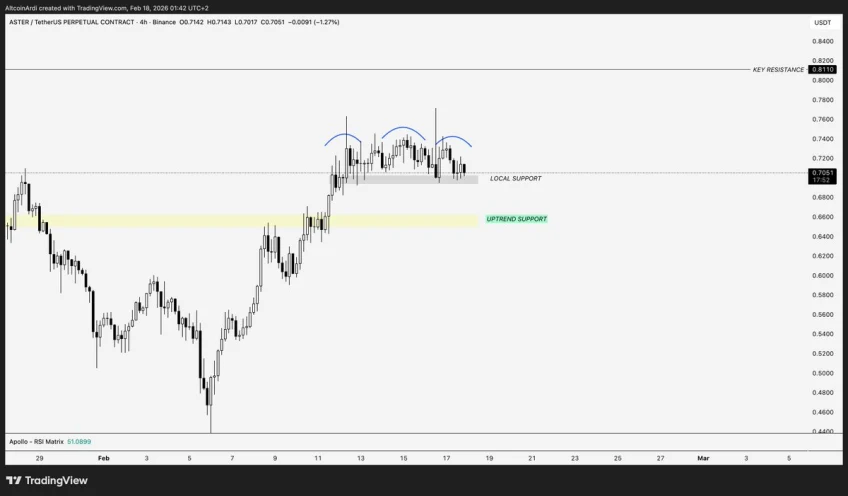
ASTER is hovering near the $0.70 level, which has acted as a reliable support floor over the past week. However, analysts note that momentum is fading, and a classic head-and-shoulders structure is forming — a pattern often linked to potential reversals.
If price slips below this zone, technical traders warn the token could revisit the $0.65 trendline, signaling increasing bearish pressure. The risk is amplified by traders trapped near $0.75, whose exit orders could accelerate a decline if support breaks.
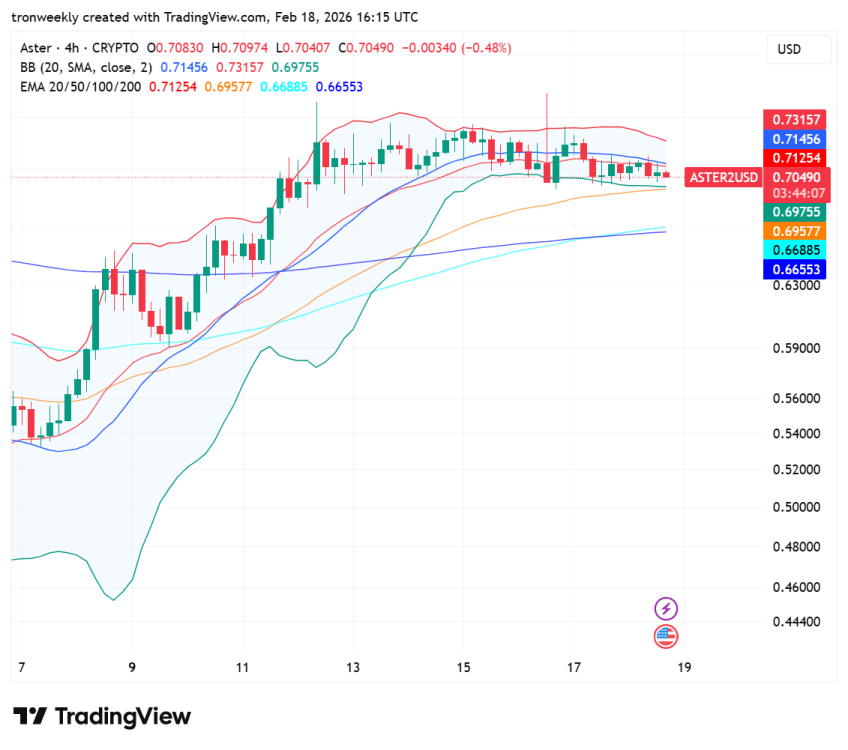
Still, indicators from TradingView show the broader trend is not decisively bearish. ASTER recently climbed from the low $0.50 range, supported by higher-timeframe EMAs. With Bollinger Bands tightening and price locked between $0.70 and $0.73, the market appears to be waiting for a decisive breakout above $0.731 or a drop below $0.697.
Momentum Signals Suggest Consolidation, Not Panic
Momentum indicators reinforce the idea of a pause rather than a collapse. The RSI sits just below neutral, showing mild bearish bias but no oversold conditions. Meanwhile, the MACD’s slightly negative reading indicates weakening selling pressure.
Together, these signals point to consolidation following ASTER’s earlier rebound. The next directional move will likely depend on whether buyers defend the current support zone or surrender it.
Bitcoin Cycles May Depend on Treasury Liquidity
Beyond short-term chart patterns, macro research from Keyrock suggests that fiscal liquidity — not central bank policy — may be the dominant force behind Bitcoin cycles.
The report finds a strong historical relationship between U.S. Treasury Bill issuance and Bitcoin performance, with liquidity changes often preceding price moves by roughly eight months. As government spending injects funds into the private sector, capital eventually flows into risk assets like crypto.
Also Read: Public Masterpiece Announces PMT Chain, A Layer 1 Built for the Real-World Asset Economy
Data tracked via CoinMarketCap shows Bitcoin trading near $66,000 amid tighter liquidity conditions. Yet the study argues that future debt refinancing needs could reverse this trend. With trillions in U.S. debt set for rollover, increased Treasury issuance could boost liquidity and potentially fuel crypto demand into late 2026 or early 2027.
While ASTER’s immediate direction hinges on a narrow technical battleground, Bitcoin’s next major cycle may be shaped by macro liquidity rather than interest-rate policy. Together, these signals highlight a market balancing short-term price structure with long-term financial forces — a combination that could define crypto’s trajectory over the coming year.
Disclaimer: The information in this article is for general purposes only and does not constitute financial advice. The author’s views are personal and may not reflect the views of Chain Affairs. Before making any investment decisions, you should always conduct your own research. Chain Affairs is not responsible for any financial losses.

I’m your translator between the financial Old World and the new frontier of crypto. After a career demystifying economics and markets, I enjoy elucidating crypto – from investment risks to earth-shaking potential. Let’s explore!