
|
Getting your Trinity Audio player ready...
|
- Polygon burned over 107 million POL tokens in 2026, reducing supply pressure.
- Payment activity and staking growth show improving network fundamentals.
- POL price remains weak due to technical selling pressure and bearish momentum.
Polygon (POL) is showing a major disconnect between its network performance and market price. While the token has faced renewed selling pressure and recently dropped below a key support level, activity on the blockchain continues to expand, highlighting stronger fundamentals beneath the short-term price weakness.
The POL price has fallen more than 1% in the past 24 hours, trading near $0.06948 after losing support around $0.07161. However, the decline comes as Polygon records growing payment activity, rising staking participation, and a shrinking token supply due to increased burns.
Polygon Becomes a Major Player in Payment Activity
Polygon has strengthened its position as one of the most active blockchain networks for payments. Its transaction volume has reached levels comparable to, and in some cases higher than, major networks such as Solana.
The network recorded the highest stablecoin volume among payment-focused chains in May, reaching approximately $198 million. The increase in transaction activity has contributed to higher base fee collections, which are used in the token-burning process.
According to Polygon co-founder and CEO Sandeep Nailwal, more than 107 million POL tokens were burned in 2026, making the network deflationary for the year. This occurred despite the creation of over 105 million new POL tokens, resulting in a net reduction in circulating supply.
Token Burns and Staking Support Polygon Fundamentals
The growing burn rate has become a key factor supporting Polygon’s long-term token economics. Unlike some competing networks that have introduced large amounts of new supply, Polygon’s fee-burning mechanism has helped offset issuance.
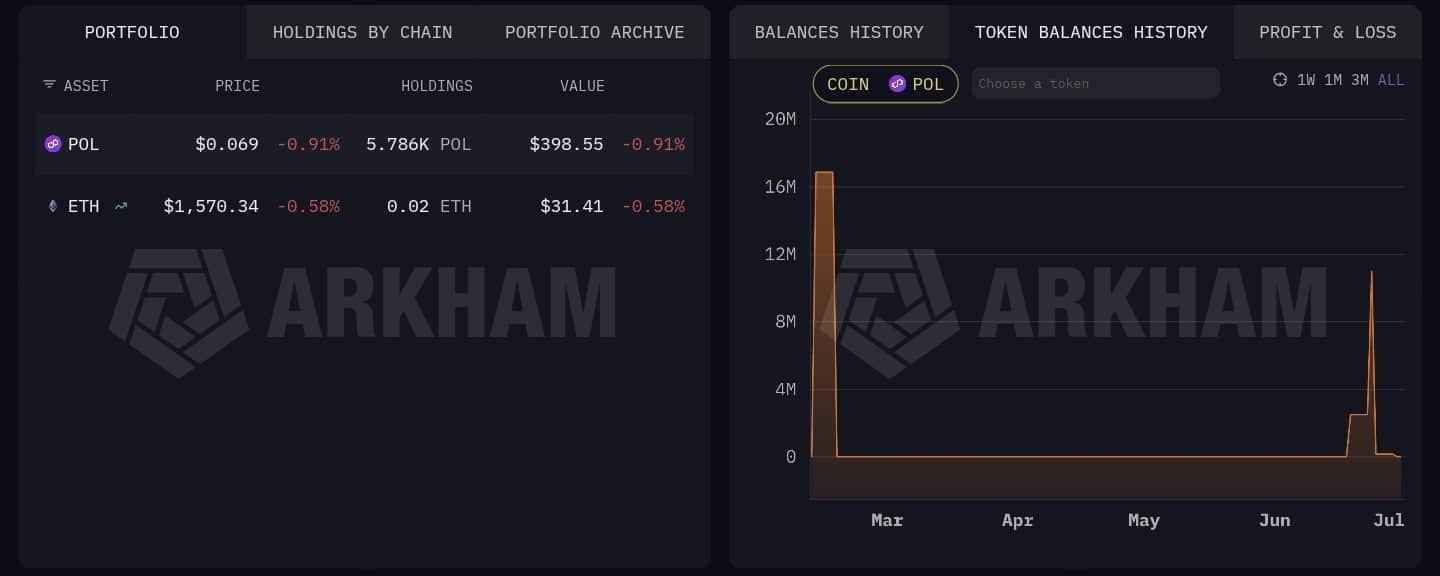
Investor activity has also remained notable. A major wallet moved 17.512 million MATIC tokens into an equivalent amount of POL, valued at around $1.25 million, suggesting continued confidence from large holders.
Staking activity has also increased. A multisig wallet connected with Stader Labs and Polygon staked 11 million POL worth roughly $839,000. The wallet now holds more than 28 million POL staked, reducing available market supply while supporting network security.
Why Is POL Price Falling Despite Strong Fundamentals?
Despite positive developments, Polygon’s price chart remains under pressure. The token has been declining since late 2024 and has entered a prolonged consolidation pattern shaped like a triangle, which suggests a potential breakout or further downside move.
Technical indicators currently favor sellers. The Bull Bear Power indicator has remained negative since October 2025, showing continued bearish momentum. The Cumulative Volume Delta (CVD) indicator also points to selling pressure, with around 670,000 POL tokens reportedly moved to exchanges.
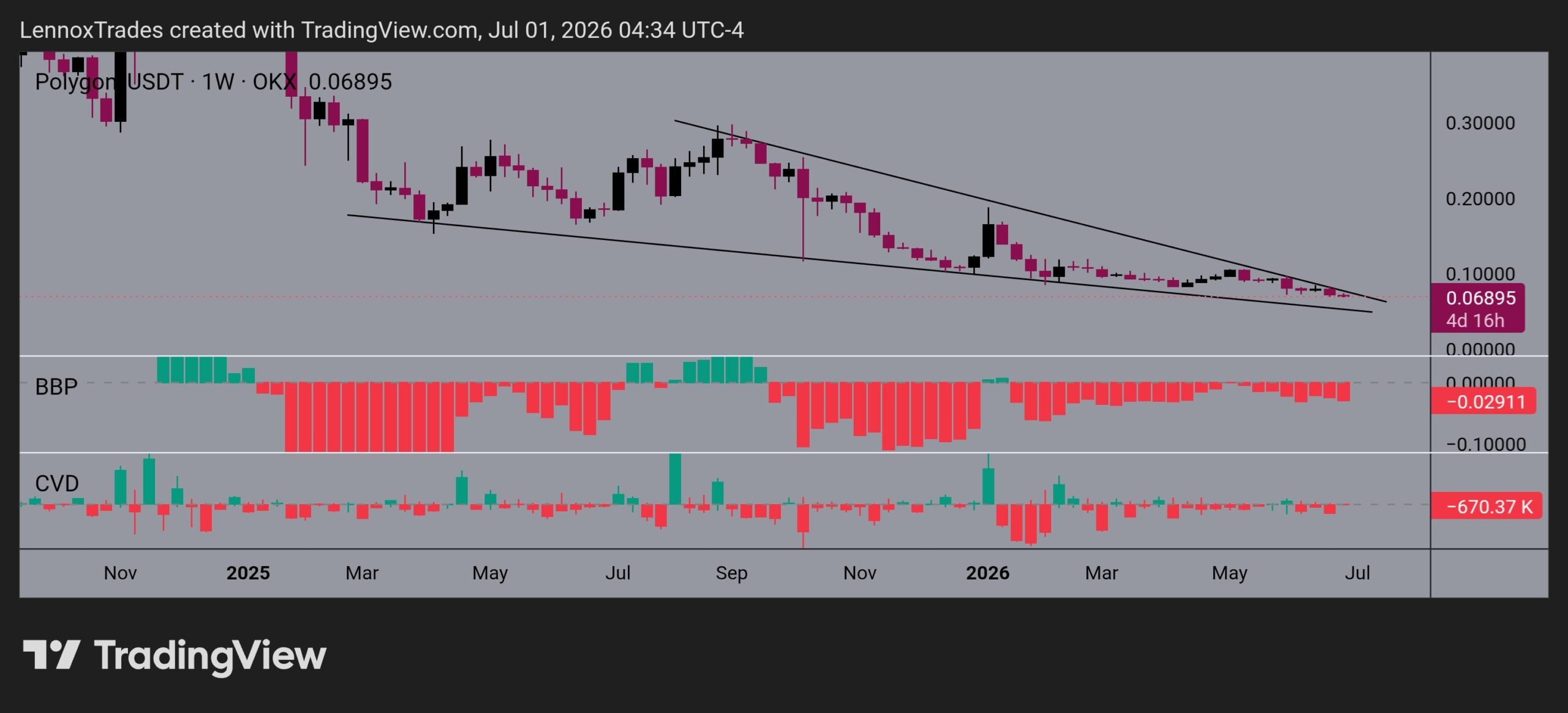
This creates a situation where Polygon’s blockchain activity is improving, but market sentiment remains cautious. Strong fundamentals have not yet translated into immediate price recovery.
Also Read: Polygon (POL) Jumps 18% in Days — Can the Rally Push Toward $0.18?
Polygon’s growing transaction volume, token burns, and rising staking activity show that the network continues to develop despite POL’s weak price performance. However, investors are still watching technical signals closely as selling pressure prevents the token from gaining momentum. The next major move may depend on whether Polygon’s improving fundamentals can outweigh broader market concerns.
Disclaimer: The information in this article is for general purposes only and does not constitute financial advice. The author’s views are personal and may not reflect the views of Chain Affairs. Before making any investment decisions, you should always conduct your own research. Chain Affairs is not responsible for any financial losses.

I’m your translator between the financial Old World and the new frontier of crypto. After a career demystifying economics and markets, I enjoy elucidating crypto – from investment risks to earth-shaking potential. Let’s explore!