
|
Getting your Trinity Audio player ready...
|
- ETH exchange inflows have increased, raising concerns about possible selling pressure.
- Futures open interest and leverage have dropped sharply, showing weaker trader confidence.
- Ethereum’s $1,400–$1,700 support zone could determine its next major price direction.
Ether (ETH) is facing renewed pressure as market data points to weaker trading activity, rising exchange supply, and declining investor appetite. Recent blockchain and derivatives indicators suggest that while some technical signals hint at a possible recovery, sellers remain in control around key price levels.
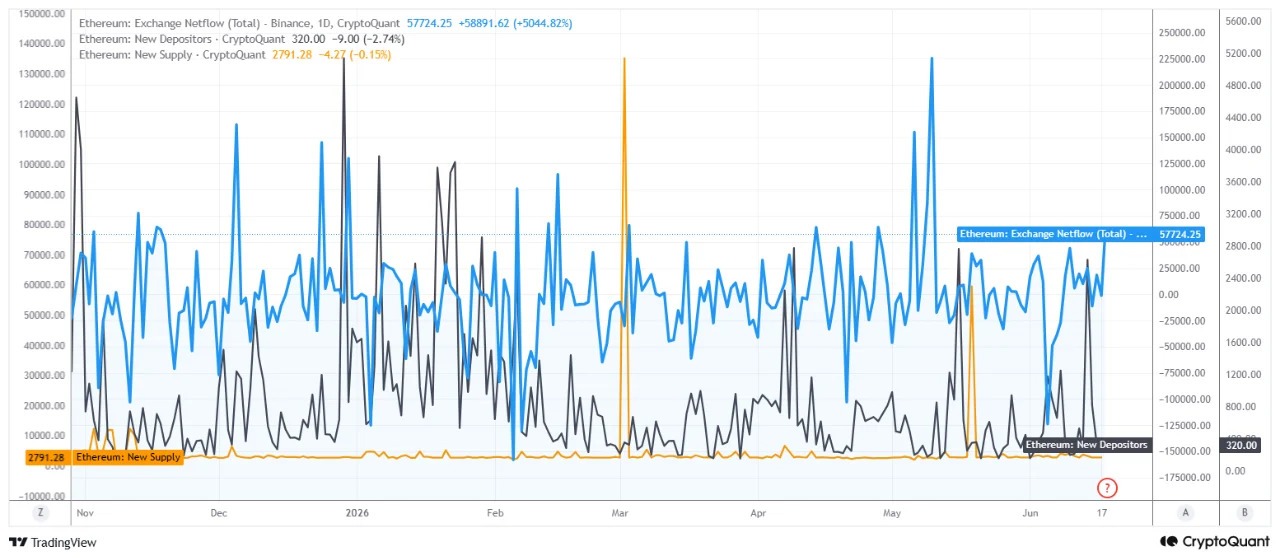
The latest market trends show Binance recording a net inflow of approximately 57,700 ETH, a move that has raised concerns among analysts because large transfers into major exchanges can indicate that holders may be preparing to sell. At the same time, futures activity has cooled significantly, adding to uncertainty around Ethereum’s short-term direction.
ETH Exchange Inflows Signal Possible Selling Pressure
Crypto analyst Pelin Ay highlighted that Ethereum deposits into Binance have increased while new participation remains limited. Around 320 new ETH deposit addresses have appeared recently, a level considered weak compared with previous periods of strong market demand.
The combination of higher exchange inflows and fewer new buyers suggests that current price support may depend mostly on existing holders rather than fresh capital entering the market.
Ethereum’s daily supply growth remains relatively low following the implementation of the EIP-1559 upgrade, with issuance estimated near 2,791 ETH per day. However, reduced supply growth has not fully offset the impact of weaker demand and increased exchange activity.
Futures Market Shows Declining Trader Confidence
Ethereum derivatives markets are also showing signs of caution. Futures open interest has dropped from around $15 billion a month ago to approximately $10.3 billion, marking a decline of nearly 31%.
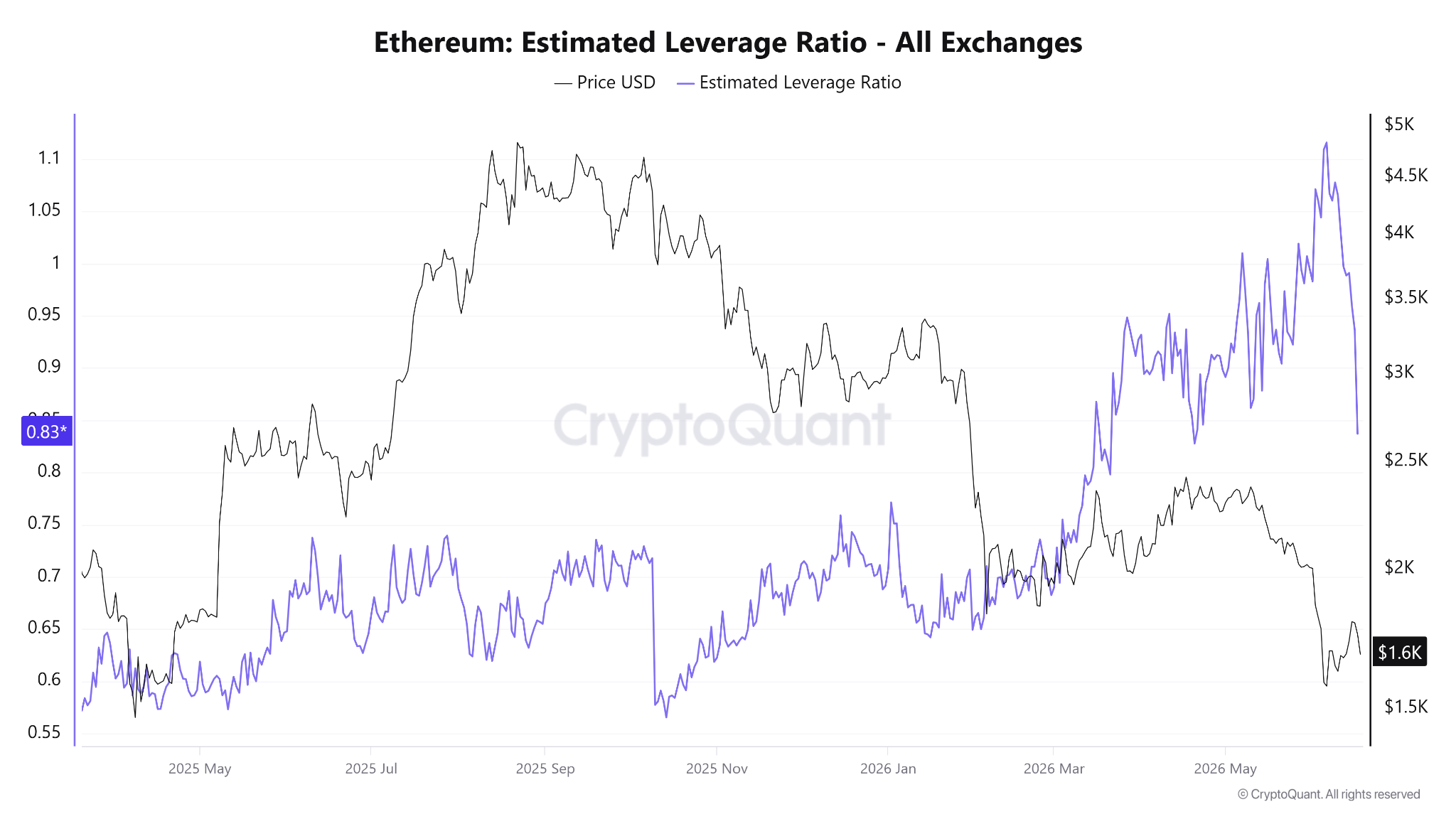
The estimated leverage ratio across exchanges has also fallen from 1.10 earlier in June to 0.83. While lower leverage can reduce extreme market swings, it also reflects reduced confidence among traders and less speculative activity.
The decline suggests that many traders have scaled back risk exposure as ETH struggles to regain momentum.
Can ETH Hold the $1,700 Support Zone?
Ether’s price has fallen about 30% over the past 42 days and is currently trading near an important demand area between $1,700 and $1,400. A break below this range could expose ETH to further downside, with the April 2025 low near $1,384 becoming a potential target.
However, some analysts believe Ethereum may be approaching a possible bottom. Trader Ardi pointed to improving technical conditions, including oversold momentum indicators. The weekly RSI is near 31 after the daily RSI reached a historic low during the recent sell-off, suggesting selling pressure may be weakening.
The ETH/BTC trading pair remains another important indicator, as its continued decline shows Ethereum is still struggling against Bitcoin’s market strength.
Also Read: Ethereum Hits Record Growth in 2026 as Users Surge and Tokenization Explodes
Ethereum’s short-term outlook remains uncertain as exchange inflows rise and derivatives activity declines. While weaker leverage and oversold conditions could create room for recovery, ETH must defend the $1,400–$1,700 support zone to avoid deeper losses. Traders will likely watch exchange flows, futures demand, and technical signals closely for clues about Ethereum’s next major move.
Disclaimer: The information in this article is for general purposes only and does not constitute financial advice. The author’s views are personal and may not reflect the views of Chain Affairs. Before making any investment decisions, you should always conduct your own research. Chain Affairs is not responsible for any financial losses.

I’m a crypto enthusiast with a background in finance. I’m fascinated by the potential of crypto to disrupt traditional financial systems. I’m always on the lookout for new and innovative projects in the space. I believe that crypto has the potential to create a more equitable and inclusive financial system.