
|
Getting your Trinity Audio player ready...
|
- Vitalik Buterin believes AI-assisted formal verification can significantly improve software security.
- Ethereum projects are already experimenting with mathematically verified infrastructure.
- Bitcoin whale wallets continue growing despite heavy market volatility and investor fear.
As crypto markets struggle with volatility and geopolitical uncertainty, two separate trends are shaping the industry’s long-term outlook: Ethereum’s push toward AI-powered software security and Bitcoin whales quietly increasing their exposure during market weakness.
Ethereum co-founder Vitalik Buterin recently argued that artificial intelligence could strengthen, rather than destroy, the future of secure software development. At the same time, on-chain data show major Bitcoin holders continuing to accumulate BTC despite sharp price swings and heavy market fear.
Vitalik Buterin Says AI Could Make Software Safer
In a detailed discussion on formal verification, Buterin challenged the growing belief that AI-driven cyberattacks will eventually make secure code impossible.
Formal verification uses mathematical proofs to confirm software behaves exactly as intended under every possible condition. Instead of relying on testing alone, developers create proofs that computers can automatically validate.
The process has historically been slow and difficult because writing proofs manually requires deep technical expertise. Buterin believes AI changes that equation by helping developers generate both the code and the mathematical proofs needed to verify it.
According to him, this could become a breakthrough moment for high-security systems like Ethereum infrastructure, operating systems, and sensitive internet-connected devices.
Ethereum’s Security Stack Is Already Evolving
Buterin highlighted several Ethereum-related projects already experimenting with formal verification.
These include quantum-resistant cryptography, STARK proof systems, consensus mechanisms, and ZK-EVM development. Projects such as Arklib and evm-asm are working toward mathematically verified implementations designed to reduce the risk of catastrophic bugs.
Still, Buterin acknowledged important limitations. Even verified software can fail if developers overlook key assumptions, write flawed specifications, or face hardware-level vulnerabilities like side-channel attacks.
Rather than promising perfect software, Buterin framed formal verification as a way to dramatically reduce uncertainty in critical systems.
Bitcoin Whales Continue Buying Despite Fear
While Ethereum focuses on future infrastructure, Bitcoin’s largest holders appear focused on long-term accumulation.
The number of wallets holding at least 100 BTC has climbed to 20,229, up more than 11% over the past year. The increase comes even as Bitcoin experienced heavy volatility and a sharp pullback from recent highs.
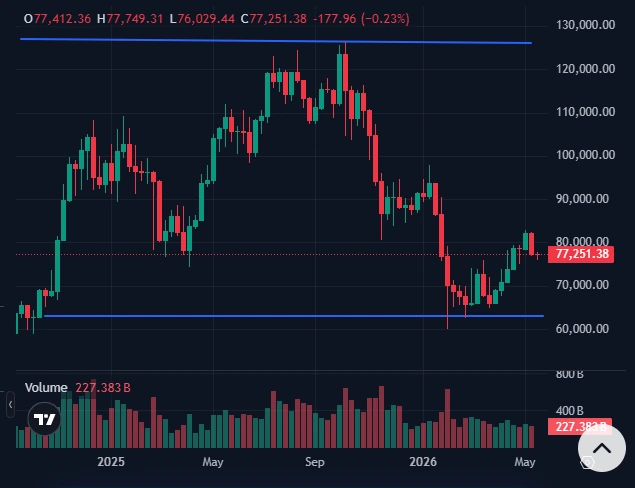
Recent geopolitical tensions between the US and Iran triggered broader market risk aversion, helping push Bitcoin below $77,000 and causing major liquidations across leveraged positions.
At the same time, digital asset investment products recorded over $1 billion in outflows last week, with Bitcoin accounting for most of the withdrawals.
Despite the fear-driven environment, blockchain analytics firm Santiment noted that whale accumulation continues to rise while retail investors remain cautious.
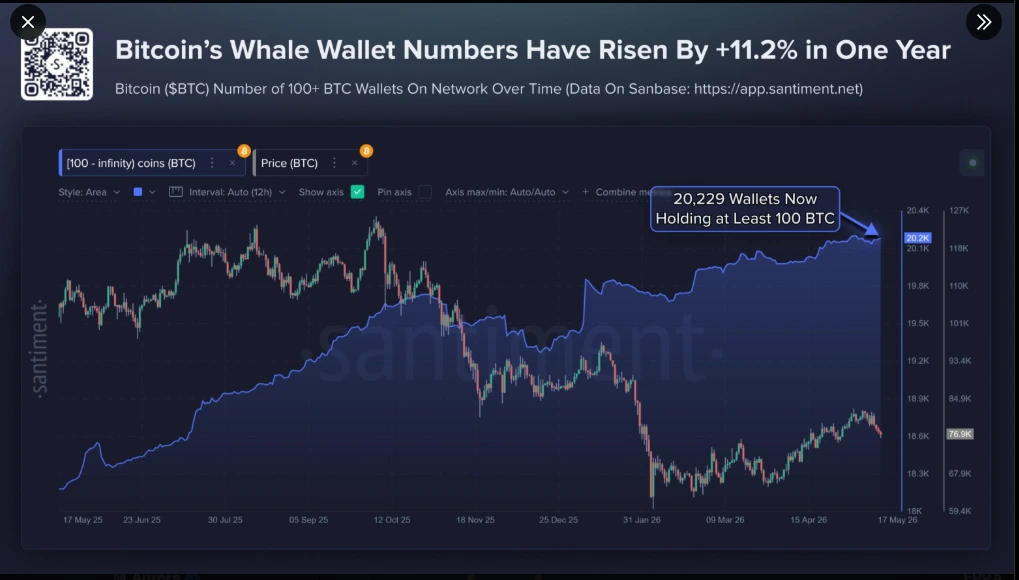
Historically, growing whale wallet counts have often signaled long-term confidence in Bitcoin’s scarcity and future value. Analysts also note that periods of retail panic frequently coincide with accumulation phases from institutional and high-net-worth investors.
Whether that trend continues may depend heavily on broader geopolitical developments and overall market sentiment in the weeks ahead.
Also Read: Vitalik Buterin Backs Decentralized Messaging: Can Session Solve Encryption’s Metadata Problem?
The crypto market is currently balancing two competing realities: short-term uncertainty and long-term conviction. While Bitcoin whales continue accumulating through volatility, Ethereum developers are exploring AI-assisted verification systems that could reshape software security for decades.
Together, both narratives point to an industry still investing heavily in its future, even during periods of fear and instability.
Disclaimer: The information in this article is for general purposes only and does not constitute financial advice. The author’s views are personal and may not reflect the views of Chain Affairs. Before making any investment decisions, you should always conduct your own research. Chain Affairs is not responsible for any financial losses.

I’m your translator between the financial Old World and the new frontier of crypto. After a career demystifying economics and markets, I enjoy elucidating crypto – from investment risks to earth-shaking potential. Let’s explore!