|
Getting your Trinity Audio player ready...
|
- Fidelity International launches a blockchain-based liquidity fund with AAA-mf rating from Moody’s.
- Chainlink enables real-time NAV and distribution tracking for improved transparency.
- Institutional adoption of tokenized money market funds is rapidly accelerating worldwide.
Global asset manager Fidelity International has taken a major step into blockchain-based finance with the launch of a tokenized liquidity product designed to bring traditional cash instruments onchain. The new Fidelity USD Digital Liquidity Fund (FILQ), assessed by Moody’s Ratings, signals growing institutional confidence in tokenized real-world assets and blockchain infrastructure.
The move comes as major financial institutions race to digitize short-term yield products, blending traditional market stability with blockchain efficiency.
Fidelity Launches FILQ With AAA-mf Stability Assessment
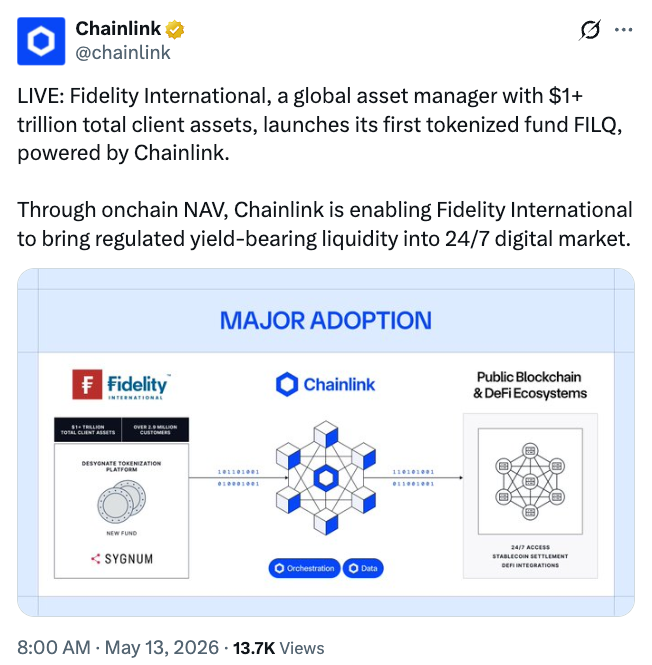
The Fidelity USD Digital Liquidity Fund (FILQ) has received a AAA-mf rating from Moody’s, a designation typically reserved for money market funds with strong credit quality and liquidity profiles. The fund is issued through blockchain infrastructure connected to Chainlink Labs and launched via Sygnum Bank’s tokenization platform.
According to Sygnum, the structure is designed to offer regulated, yield-bearing liquidity in a tokenized format. Fatmire Bekiri, head of tokenization at Sygnum, described the launch as a meaningful step toward modern capital markets, where traditional assets can operate seamlessly on blockchain networks.
Chainlink Powers Real-Time Fund Transparency
A key feature of FILQ is its integration with Chainlink’s oracle infrastructure, which enables real-time delivery of net asset value (NAV) and distribution data directly onchain. This allows investors to track fund performance with greater transparency and reduced delay compared to traditional reporting systems.
Chainlink’s capital markets president Fernando Vazquez noted that using verifiable data feeds helps bridge conventional finance with decentralized systems. JPMorgan is also expected to contribute approved daily NAV data, further strengthening data reliability across the fund’s reporting structure.
Institutional Momentum Builds in Tokenized Markets
FILQ joins a growing wave of tokenized money market and treasury products launched by major financial players, including BlackRock and Franklin Templeton. These offerings aim to bring low-risk, short-term yield instruments onto blockchain networks, improving accessibility and settlement efficiency.
Meanwhile, other initiatives—such as JPMorgan’s planned Ethereum-based tokenized fund and Fidelity Investments’ earlier digital interest products—show how quickly tokenized finance is evolving across jurisdictions and institutions.
Also Read: $300B Stablecoin Market Gets a New Giant as Fidelity Unveils FIDD
The launch of FILQ highlights a broader shift: traditional asset managers are no longer testing blockchain at the edges—they are building core financial products on it.
Fidelity’s latest move underscores accelerating institutional adoption of tokenized real-world assets. With blockchain transparency, regulated oversight, and established credit ratings converging, tokenized liquidity funds may soon become a standard part of global capital markets.
Disclaimer: The information in this article is for general purposes only and does not constitute financial advice. The author’s views are personal and may not reflect the views of Chain Affairs. Before making any investment decisions, you should always conduct your own research. Chain Affairs is not responsible for any financial losses.

I’m your translator between the financial Old World and the new frontier of crypto. After a career demystifying economics and markets, I enjoy elucidating crypto – from investment risks to earth-shaking potential. Let’s explore!