
|
Getting your Trinity Audio player ready...
|
- OKX APP enables AI agents to pay, negotiate, and execute transactions autonomously.
- The system supports escrow, cross-chain payments, and stablecoin microtransactions.
- Big tech and crypto firms are racing to define AI payment infrastructure standards.
Cryptocurrency exchange OKX has introduced a new open payments framework designed specifically for artificial intelligence agents, marking another major step toward fully automated digital commerce. The system, called the Agent Payments Protocol (APP), aims to allow software agents to pay, negotiate, and complete transactions with minimal human involvement. As competition intensifies across the tech and crypto sectors, OKX is positioning itself at the center of an emerging infrastructure race for machine-to-machine payments.
What the Agent Payments Protocol (APP) Does
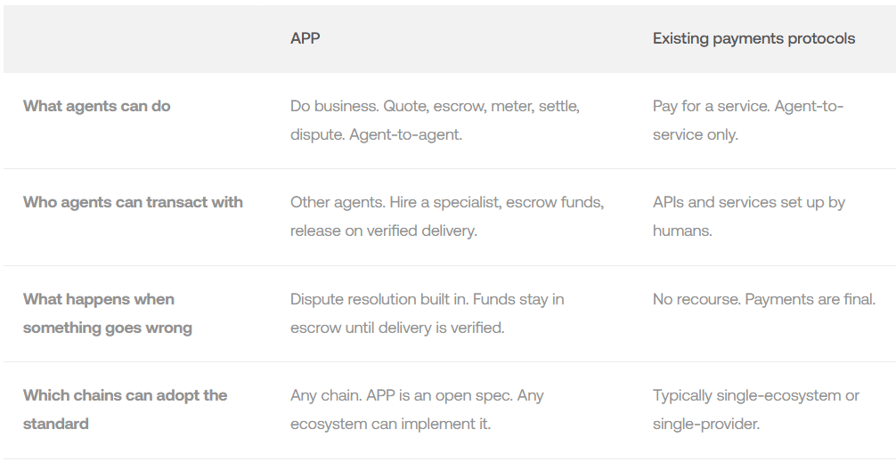
The APP framework is designed as a cross-chain standard that enables AI agents to conduct financial operations independently. Instead of simply initiating payment requests, agents can now communicate directly, agree on terms, and execute transactions across different workflows.
OKX says the system supports recurring payments, top-ups, and automated business processes. It also introduces more advanced capabilities such as escrow management, where funds are held until a task is verified as complete before being released. This creates a trust layer for automated digital work between independent AI systems.
How AI Agents Pay and Work Together
At the core of APP is OKX’s self-custodial Agentic Wallet and Payment SDK, which runs on its X Layer network and supports cross-chain transactions. In practice, an AI agent can query real-time data, receive a payment request, and settle it instantly through an HTTP 402-style mechanism—meaning payment is triggered per interaction or service call.
Agents can also outsource tasks to specialized sub-agents, with payments locked in escrow until verification is confirmed. OKX further highlights the possibility of gas-free stablecoin transfers on X Layer, making microtransactions more efficient and cost-effective for machine-driven activity.
Also Read: BlackRock + OKX: The Game-Changing Move Bringing Wall Street Into Crypto
Competition in the AI Payments Infrastructure Race
OKX is not alone in this push. Google has promoted its AP2 protocol, while Coinbase has introduced its x402 standard. Meanwhile, payment giants like Visa and companies linked with Stripe are also exploring frameworks for AI-driven transactions. The competition reflects a broader effort to define how machines will handle payments in an increasingly automated digital economy.
Industry analysts suggest that stablecoins could play a central role in enabling machine-to-machine payments. Their programmable nature and low transaction costs make them suitable for microtransactions between AI systems. As automation expands across industries, protocols like APP may become foundational for scalable digital commerce without human intervention.
OKX’s Agent Payments Protocol represents a step toward a future where AI agents not only communicate but also transact autonomously. As multiple tech giants race to define payment standards for machines, the outcome could reshape how digital services are bought, sold, and automated across global markets.
Disclaimer: The information in this article is for general purposes only and does not constitute financial advice. The author’s views are personal and may not reflect the views of Chain Affairs. Before making any investment decisions, you should always conduct your own research. Chain Affairs is not responsible for any financial losses.

I’m your translator between the financial Old World and the new frontier of crypto. After a career demystifying economics and markets, I enjoy elucidating crypto – from investment risks to earth-shaking potential. Let’s explore!