
|
Getting your Trinity Audio player ready...
|
- Robinhood missed revenue and EPS expectations, triggering a 6% after-hours stock drop.
- Crypto trading weakness offset gains in equities and options.
- Strong user growth wasn’t enough to meet high investor expectations.
Shares of Robinhood Markets Inc. (NASDAQ: HOOD) fell sharply in after-hours trading after the company reported first-quarter 2026 results that failed to meet Wall Street expectations. Despite year-over-year growth across key metrics, the earnings miss weighed heavily on investor sentiment, sending the stock down roughly 6% after the closing bell.
Revenue Growth Fails to Impress Investors
Robinhood posted revenue of $1.07 billion for Q1, marking a 15% increase from the same period last year. However, this figure came in below analyst expectations of $1.14 billion. Earnings per share also disappointed, landing at $0.38 versus the projected $0.40.
While net income rose modestly to $346 million, the broader market reaction suggests that investors were expecting stronger performance. The gap between projections and actual results proved significant enough to trigger a sell-off, highlighting the high expectations surrounding the fintech firm.
Mixed Performance Across Business Segments
The company reported solid growth in several areas. Interest income climbed to $359 million, while transaction-based revenue reached $623 million. Robinhood also saw continued expansion in its user base, with funded accounts increasing to 27.4 million and total assets under custody hitting $307 billion.
However, a decline in crypto trading revenue offset gains in equities and options. This weakness in digital asset activity comes at a time when crypto markets remain volatile, impacting platforms heavily reliant on trading volume.
CEO Vlad Tenev emphasized the company’s long-term vision, stating that innovation and product expansion are positioning Robinhood at the center of users’ financial lives. Still, the market appeared more focused on short-term performance gaps.
External Pressures Add to Market Concerns
Adding to the pressure, David Schwartz, associated with Ripple, recently flagged a phishing scam targeting Robinhood users. While not directly tied to earnings, such developments can influence investor confidence and user trust.
The earnings miss comes shortly after Robinhood benefited from positive momentum tied to a $75 million deal with OpenAI, making the reversal in sentiment more notable.
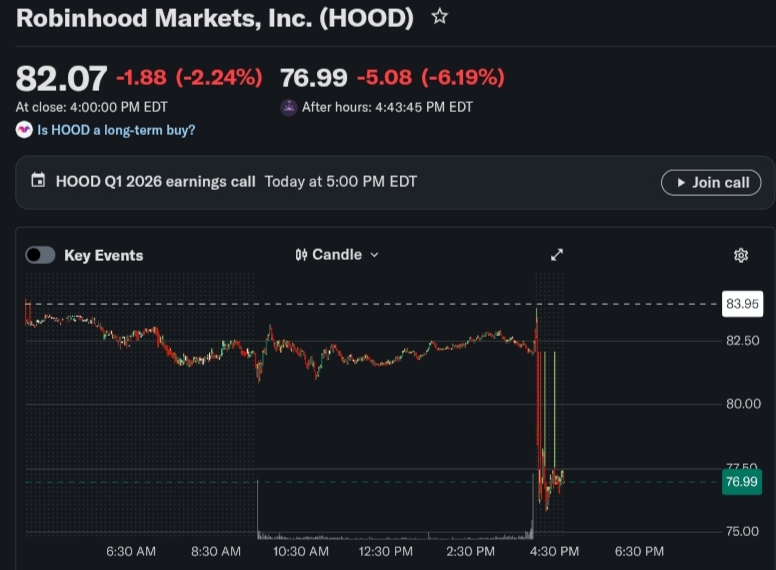
Robinhood shares closed at $82.07 on April 28 before dropping to around $76.93 in after-hours trading following the earnings release. The decline reflects a broader market reaction to unmet expectations rather than a lack of growth.
Also Read: Robinhood Joins Treasury Program: What ‘Trump Accounts’ Mean for Investors
Looking ahead, Robinhood’s ability to diversify revenue streams—particularly beyond crypto—will be key. While user growth and assets under management remain strong, consistent earnings performance will be critical to regaining investor confidence.
Robinhood’s Q1 results highlight a familiar challenge for high-growth tech firms: strong fundamentals may not be enough if expectations aren’t met. While the company continues to expand its platform and user base, short-term earnings pressure and external risks could keep the stock volatile in the near term.
Disclaimer: The information in this article is for general purposes only and does not constitute financial advice. The author’s views are personal and may not reflect the views of Chain Affairs. Before making any investment decisions, you should always conduct your own research. Chain Affairs is not responsible for any financial losses.

I’m your translator between the financial Old World and the new frontier of crypto. After a career demystifying economics and markets, I enjoy elucidating crypto – from investment risks to earth-shaking potential. Let’s explore!