|
Getting your Trinity Audio player ready...
|
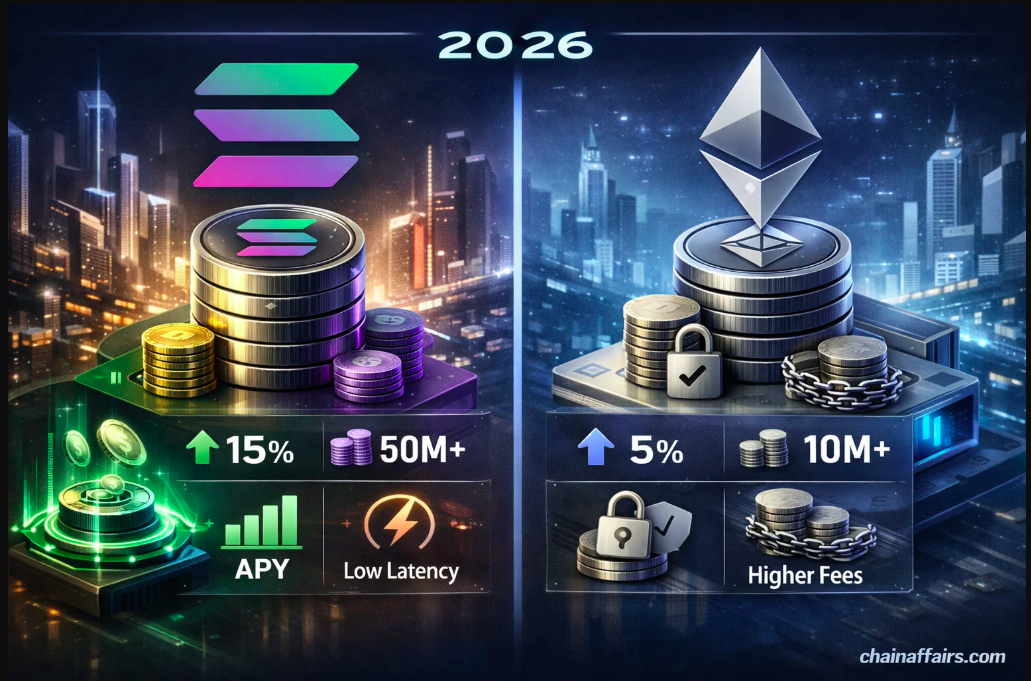
Two blockchains. Two staking models. Vastly different risk profiles — and reward structures that don’t always favor the network with the bigger brand name. As yield-hungry investors reassess their strategies heading deeper into 2026’s market cycle, the debate between Solana and Ethereum staking has never been more consequential. Here’s what the data — and the mechanics — actually say.
Why Staking Comparisons Matter More Than Ever in 2026
The post-merge Ethereum landscape and Solana‘s relentless performance upgrades have fundamentally changed what staking means for retail and institutional investors alike. Gone are the days when “staking APY” was the only metric worth considering. In 2026, the real calculus involves validator risk, slashing conditions, liquidity constraints, hardware requirements, and the compounding effect of network inflation on real yields.
Choosing wrong doesn’t just cost you yield — it can erode your principal.
How Ethereum Staking Works
Ethereum’s proof-of-stake model, active since The Merge in September 2022, requires validators to lock 32 ETH to participate in block production and attestation. Rewards are earned for proposing and attesting to blocks, with annual yields currently ranging between 3% and 4.5% depending on total ETH staked and network conditions.
The appeal is structural stability. Ethereum’s staking mechanism is battle-tested, its validator set is the most decentralized of any major PoS network, and slashing events — penalties for malicious or faulty validator behavior — remain rare due to widespread use of professional node infrastructure.
For investors who can’t meet the 32 ETH threshold (a significant capital commitment at current prices), liquid staking protocols like Lido, Rocket Pool, and Coinbase’s cbETH offer tokenized staking with no minimum, maintaining liquidity while still generating yield. This has become the dominant staking method for retail participants on Ethereum.
Ethereum Staking Risks to Understand
- Slashing: Validators caught double-signing or equivocating face partial or full stake penalties.
- Withdrawal queue: During periods of high exit demand, unstaking ETH can take days to weeks.
- Liquid staking smart contract risk: Protocols like Lido hold enormous sums in contracts that represent concentrated attack surfaces.
- Yield compression: As more ETH is staked, base rewards decline proportionally — a structural headwind for late entrants.
How Solana Staking Works
Solana uses a delegated proof-of-stake model, which means any SOL holder can stake without running a validator node — simply by delegating to an existing validator. There’s no minimum stake requirement, making Solana staking among the most accessible entry points in the industry.
Current staking yields on Solana sit between 6% and 8% annualized, meaningfully higher than Ethereum’s base rate. However, that headline number demands context: Solana’s annual inflation rate — currently on a scheduled decline toward a long-term target of 1.5% — partially offsets real yields for non-stakers while rewarding those who stake consistently.
The validator ecosystem on Solana is competitive and increasingly professionalized, with thousands of validators distributed globally. Marinade Finance and Jito are among the leading liquid staking solutions, offering mSOL and JitoSOL respectively — both of which have gained significant TVL and institutional confidence through 2025 and into 2026.
Solana Staking Risks to Understand
- Network outages: Solana’s history of partial outages, though dramatically improved, remains a reputational and operational risk for stakers during volatile periods.
- Validator concentration: A subset of high-performance validators captures disproportionate stake weight, creating centralization pressure.
- Slashing is limited but evolving: Solana currently has minimal slashing compared to Ethereum, but protocol upgrades may increase penalties as the network matures.
- Inflation dilution: Non-stakers face meaningful purchasing power erosion as SOL supply expands — a dynamic that also pressures token price.
Solana vs Ethereum Staking: Side-by-Side Comparison
| Factor | Ethereum (ETH) | Solana (SOL) |
|---|---|---|
| Consensus Model | Proof-of-Stake | Delegated Proof-of-Stake |
| Minimum Solo Stake | 32 ETH | No minimum |
| Current APY (2026 est.) | 3% – 4.5% | 6% – 8% |
| Slashing Risk | Moderate (active) | Low (limited enforcement) |
| Liquid Staking Options | Lido, Rocket Pool, cbETH | Marinade (mSOL), Jito (JitoSOL) |
| Unstaking Period | Days to weeks (queue-based) | ~2–3 day epoch cooldown |
| Network Maturity | High | Growing |
| Decentralization | Higher | Moderate |
| Inflation Impact | Low (~0.5% issuance) | Moderate (declining schedule) |
Which Offers Better Rewards for Lower Risk in 2026?
The honest answer depends entirely on your risk tolerance and investment horizon.
Ethereum staking is the lower-risk choice for investors who prioritize capital preservation, regulatory clarity, and network security above yield maximization. The lower APY is the price of stability — and in a volatile market cycle, that tradeoff is rational. Institutional allocators increasingly favor ETH staking precisely because of its predictability and the maturity of its validator infrastructure.
Solana staking offers higher yield potential for investors comfortable with a more dynamic risk profile. The higher APY, accessible entry point, and strong liquid staking ecosystem make it attractive — but the network’s younger history, inflation mechanics, and validator concentration dynamics require active monitoring rather than passive set-and-forget behavior.
For investors seeking the best of both worlds, a split allocation strategy — staking a core position in ETH for stability while capturing Solana’s higher yields with a smaller, actively managed position — has emerged as a credible approach among sophisticated retail participants in 2026.
The Liquid Staking Factor
One development that is reshaping both ecosystems equally is the explosive growth of liquid staking derivatives (LSDs). By 2026, liquid staking represents the majority of new staking inflows on both networks. The ability to stake while maintaining token liquidity — using staked positions as collateral in DeFi protocols — has fundamentally altered yield strategies.
However, liquid staking introduces layered risk: smart contract exposure, depeg risk if the LSD loses its peg to the underlying asset, and governance risks within the staking protocol itself. These risks are manageable but must be priced into any yield comparison.
Also Read: Solana vs Ethereum Staking: Key Differences and Best Rewards for Lower Risk in 2025
Final Verdict: Know What You’re Actually Buying
Staking yield percentages are marketing numbers until you account for inflation, slashing risk, liquidity constraints, and smart contract exposure. Both Ethereum and Solana offer compelling staking opportunities in 2026 — but they serve different investor profiles.
Ethereum rewards patience and security-consciousness. Solana rewards accessibility and higher risk appetite. Neither is inherently superior. What matters is alignment between the staking model and your actual financial goals.
In a market that punishes complacency, the most dangerous position is chasing the highest APY without understanding what’s underneath it.
Disclaimer: The information in this article is for general purposes only and does not constitute financial advice. The author’s views are personal and may not reflect the views of Chain Affairs. Before making any investment decisions, you should always conduct your own research. Chain Affairs is not responsible for any financial losses.