|
Getting your Trinity Audio player ready...
|
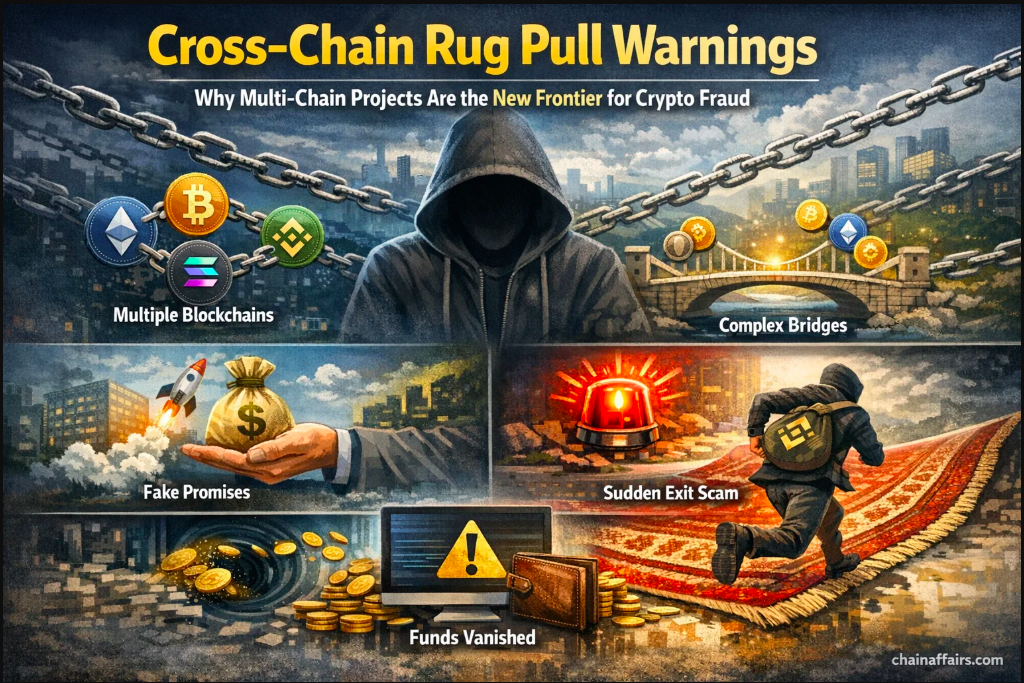
The evolution of blockchain technology was supposed to bring freedom — the ability to move assets seamlessly across networks, unlock new financial primitives, and escape the limitations of any single chain. Instead, it has also handed sophisticated fraudsters a new and largely unpoliced playground. Cross-chain rug pulls are rising sharply, and the mechanisms that make interoperability powerful are the same ones that make this breed of scam extraordinarily difficult to detect and even harder to prosecute.
If you’re investing in multi-chain projects, bridges, or cross-chain DeFi protocols, understanding the specific warning signs isn’t optional. It’s the difference between building wealth and losing it overnight.
Why Cross-Chain Projects Are Prime Rug Pull Territory
Traditional single-chain rug pulls are increasingly well-documented. Investors have learned to check liquidity locks on Uniswap, audit smart contracts on Etherscan, and trace wallet histories on one network. But cross-chain projects scatter their footprint deliberately — or at least, that’s what bad actors rely on.
When a project operates across Ethereum, BNB Chain, Avalanche, and Arbitrum simultaneously, tracking developer wallets requires monitoring four separate ecosystems in real time. Most retail investors simply don’t have the tools or the time. Fraudsters know this, and they exploit the gap aggressively.
Bridge contracts — the infrastructure that locks assets on one chain and mints equivalents on another — introduce additional attack surfaces. A single compromised or maliciously designed bridge can drain funds from multiple chains in minutes, long before on-chain alerts reach the community.
Cross-Chain Rug Pull Warning Signs to Watch
1. Unexplained Multi-Chain Launches Legitimate cross-chain expansion follows product-market fit. A project that launches on five blockchains simultaneously, before its core product is even live, is almost certainly chasing liquidity — not building infrastructure. Ask why each chain is necessary and whether the team can technically justify the deployment.
2. Unaudited or Suspiciously Audited Bridge Contracts The bridge is the most dangerous component of any cross-chain project. If the bridge contract hasn’t been audited by a credible, independent firm — or if the audit is from an obscure organization with no verifiable track record — treat the entire project as high-risk. Always read the audit report itself, not just the badge displayed on the website.
3. Opaque Cross-Chain Wallet Activity Developer and team wallets should be transparent and traceable. Use multi-chain analytics tools like Debank, Arkham Intelligence, or Nansen to map wallet flows across networks. Warning signs include wallets that receive large allocations on one chain and immediately bridge funds to a lesser-known network with thinner liquidity — a classic pre-exit maneuver.
4. Asymmetric Liquidity Across Chains Healthy cross-chain projects maintain proportional liquidity across their deployments. If a project advertises a multi-chain presence but concentrates the overwhelming majority of its liquidity on one network while listing thin pools on others, that asymmetry can signal a controlled exit setup — where developers drain the primary pool and vanish while secondary chain activity provides a distraction.
5. Governance Centralization Hidden Behind Multi-Chain Complexity Cross-chain governance structures can obscure who actually controls a protocol. If a single multisig wallet or a small group of addresses holds administrative rights across all chain deployments — particularly with short or nonexistent timelocks — those controllers can upgrade, pause, or drain contracts at will. Always identify who holds the keys, on every chain.
6. Suspicious Token Bridge Mechanics Pay close attention to how tokens move between chains. Wrapped tokens that rely on centralized custodians, bridges with unlimited minting authority, or token contracts where the bridge operator can mint supply without restriction are structural vulnerabilities that bad actors engineer intentionally. These aren’t edge cases — they’re design choices.
Also Read: How to Spot a Rug Pull Before It Happens 2025: 7 Proven On-Chain Warning Signs
The Tools You Need to Stay Protected
Protecting yourself in the cross-chain landscape requires going beyond single-chain due diligence:
- Debank & Arkham Intelligence — Track wallet movements across multiple networks simultaneously.
- Etherscan, BscScan, Snowtrace — Audit contracts on each chain individually; don’t assume a clean Ethereum contract means clean deployments elsewhere.
- Rugdoc.io & Token Sniffer — Flag malicious functions in token and bridge contracts.
- L2Beat — For Layer 2 and bridge-specific risk assessments, this resource provides independent security scoring.
- DeFiLlama — Monitor TVL (Total Value Locked) movements in real time; a sudden, unexplained TVL drop is a five-alarm warning.
What a Real Cross-Chain Rug Pull Looks Like
The pattern is consistent: a project generates strong community momentum, deploys across multiple chains to maximize liquidity capture, and then — often triggered by a market downturn or a competitor launch — executes a rapid multi-chain exit. Funds bridge from smaller chains to a central address, liquidity is removed, and the team disappears. By the time on-chain investigators piece together the trail, the funds have passed through multiple mixers across three or four networks.
The sophistication of these exits is increasing. Some cross-chain rug pulls now use automated scripts to execute withdrawals across chains in coordinated sequences — entire operations completed in under ten minutes.
The Hard Truth About Cross-Chain Risk
The promise of a fully interoperable blockchain ecosystem is real and worth pursuing. But the infrastructure is still maturing, regulatory oversight remains fragmented, and the technical complexity creates information asymmetries that scammers exploit ruthlessly.
Until cross-chain security standards are formalized and independent auditing becomes a non-negotiable baseline — not a marketing checkbox — investors must treat multi-chain projects with a higher burden of proof than single-chain alternatives. The upside may be real. The risk is equally so.
Verify everything. Trust nothing you can’t trace on-chain. And when the warning signs appear, treat them as facts — not possibilities.
Disclaimer: The information in this article is for general purposes only and does not constitute financial advice. The author’s views are personal and may not reflect the views of Chain Affairs. Before making any investment decisions, you should always conduct your own research. Chain Affairs is not responsible for any financial losses.

I’m your translator between the financial Old World and the new frontier of crypto. After a career demystifying economics and markets, I enjoy elucidating crypto – from investment risks to earth-shaking potential. Let’s explore!