
|
Getting your Trinity Audio player ready...
|
- Hoskinson argues XRP would have launched as a security under H.R. 3633.
- Ripple supports regulatory clarity despite criticism.
- Bitcoin shows institutional strength, with ETFs recording $458M inflows.
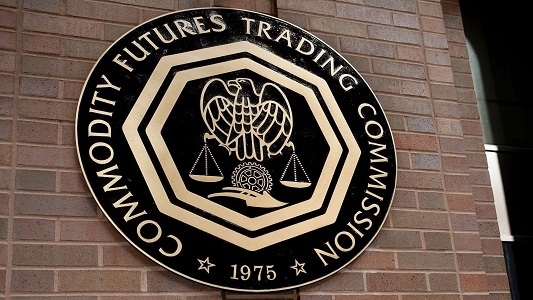
The debate over U.S. crypto regulation intensified this week as Cardano founder Charles Hoskinson warned that the proposed Crypto Clarity Act could have classified XRP as a security at launch — a claim that directly challenges Brad Garlinghouse, who supports the bill.
At the same time, Bitcoin showed notable resilience during fresh geopolitical tensions involving the U.S., Israel, and Iran, briefly dipping before rebounding sharply. Together, the regulatory debate and Bitcoin’s price strength are shaping investor sentiment across the crypto market.
Hoskinson: XRP Would Have Started as a Security
Speaking in a recent broadcast, Hoskinson argued that the Crypto Clarity Act (H.R. 3633) shifts the burden onto crypto projects to prove they are no longer securities. In his view, that framework could trap blockchain networks in prolonged legal uncertainty.
Using XRP as an example, he said the token likely would have been classified as an “investment contract asset” at launch in 2012. At that time, the XRP Ledger was largely controlled by its founders before the formation of Ripple Labs. Because of that early centralization, Hoskinson believes XRP would not have qualified as a sufficiently decentralized network under the bill’s structure.
He warned that many major cryptocurrencies — including XRP, Cardano, and Ethereum — may have initially fallen into the same category.
Ripple CEO Backs Regulatory Clarity
Garlinghouse has taken a different position. He argues that clear legislation is preferable to ongoing regulatory ambiguity. According to him, structured rules would provide certainty to companies and institutional investors operating in the U.S.
Support for the bill appears to be growing. Leaders at major firms, including JPMorgan Chase and Coinbase, have expressed confidence that meaningful crypto legislation could pass this year. Market participants now see mid-year approval as increasingly plausible.
Bitcoin Shows Strength Amid Global Tensions
While Washington debates crypto regulation, Bitcoin demonstrated resilience during a war-like geopolitical shock. BTC briefly dropped to $63,000 following U.S.-Israel-Iran tensions but quickly recovered near $67,000 by February 28.
Institutional confidence appears strong. Bitcoin spot ETFs recorded $458 million in inflows on March 2, with no net outflows across active funds. Funding rates have also turned positive, signaling renewed demand for long positions.
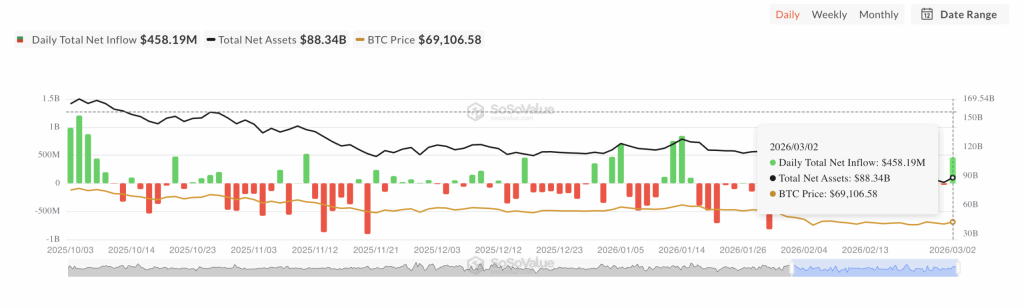
Technically, Bitcoin remains in a horizontal channel formed since early February. Price is currently holding a key support zone around $65,000–$65,700. A move toward $69,600 could open the path to $75,000 if momentum strengthens. However, a breakdown below $63,800 would weaken the bullish outlook.
Also Read: Cardano Eyes $15B DeFi Growth as Charles Hoskinson Pushes Bitcoin and XRP Integration
The Crypto Clarity Act is meant to bring order to U.S. digital asset markets, but critics like Hoskinson argue it could unintentionally classify early-stage projects as securities. Meanwhile, Bitcoin’s ability to absorb geopolitical shocks has reinforced confidence among institutional investors.
As regulation and macro events unfold, both policy and price action will likely shape the next chapter of the crypto market.
Disclaimer: The information in this article is for general purposes only and does not constitute financial advice. The author’s views are personal and may not reflect the views of Chain Affairs. Before making any investment decisions, you should always conduct your own research. Chain Affairs is not responsible for any financial losses.

I’m your translator between the financial Old World and the new frontier of crypto. After a career demystifying economics and markets, I enjoy elucidating crypto – from investment risks to earth-shaking potential. Let’s explore!