|
Getting your Trinity Audio player ready...
|
- Trust via Math: Centralized AI is a “black box” risk; decentralized protocols make AI output mathematically verifiable.
- AI Currency: Legacy banks are too slow for bots; crypto is the only native payment rail for autonomous AI agents.
- Open Compute: Decentralized networks (DePIN) break the Big Tech hardware monopoly by sourcing global, idle GPUs.
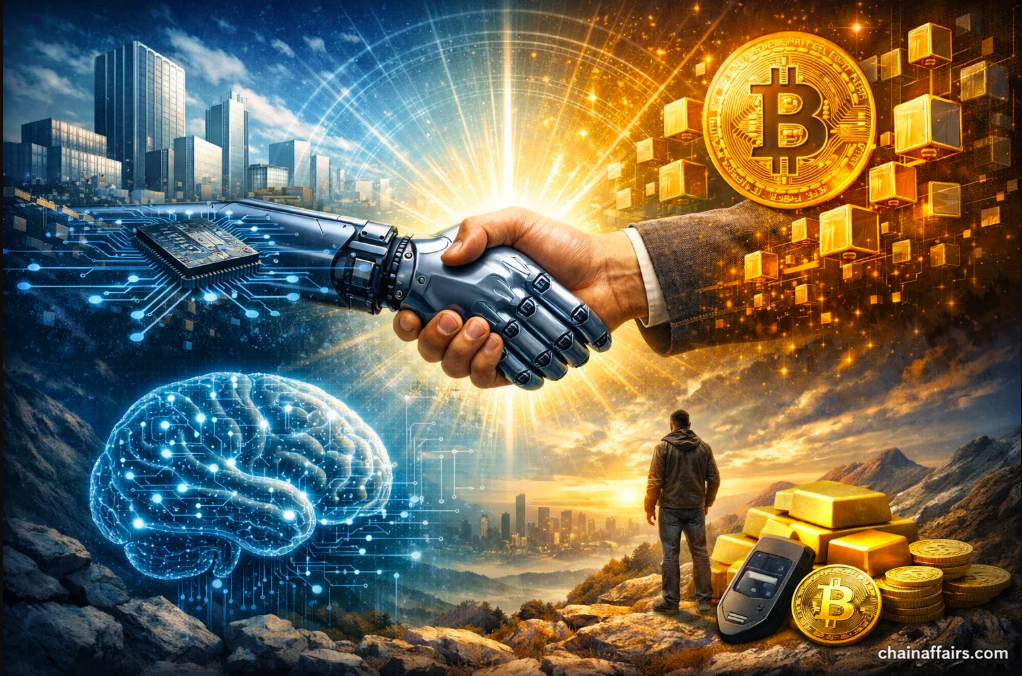
The defining conflict of the 21st century will not be fought over borders, but over the architecture of intelligence. On one side stands the radical centralization of power—the “Compute Giants” of Silicon Valley who are turning human knowledge into a proprietary subscription service. On the other side stands the radical decentralization of trust—the cryptographic protocols born from Satoshi Nakamoto’s lineage.
We are currently witnessing the “Silicon-Satoshi Convergence.” This is the structural integration of Artificial Intelligence and Blockchain, a merger that promises to move the production, validation, and distribution of intelligence out of corporate silos and onto transparent, incentivized protocols. It is the birth of Sovereign Intelligence.
The Walls of AI Feudalism
To understand why we must decentralize AI, we must first recognize the physics of the current paradigm. The “Scaling Laws” of modern transformers have turned intelligence into a function of raw capital. With the cost of training a frontier model projected to surpass the billion-dollar mark, we have entered an era of AI Feudalism.
| Feature | Centralized AI (Big Tech) | Decentralized AI (The Convergence) |
|---|---|---|
| Compute Access | Permissioned; Private H100 Clusters | Permissionless; Global DePIN Marketplaces |
| Data Control | Opaque; Data Silos | Transparent; User-Owned/Incentivized |
| Monetization | Subscription-based (Rent-seeking) | Tokenized Ownership & Protocol Rewards |
| Censorship | High; Controlled by Corporate Boards | Low; Governed by Code and Consensus |
In this system, access is permissioned. Smaller startups and independent researchers are priced out of the hardware required for relevance. Furthermore, the models themselves remain “black boxes”—opaque structures where weights, training data, and alignment techniques are guarded like state secrets. The value generated by the collective data of the internet is being vacuumed upward into the balance sheets of a few cloud monopolies.
The Verification Frontier: Solving for Truth
The greatest technical challenge in this transition is the “Proof-of-Inference” problem. If you send a prompt to a decentralized node, how can you be certain the response came from the high-tier model you paid for, rather than a cheaper imitation?
The answer lies in Zero-Knowledge Machine Learning (zkML) and other verification layers.
| Verification Method | Mechanism | Primary Strength | Trade-off |
|---|---|---|---|
| Optimistic Proofs | Assumes honesty; challenged via fraud proofs | High Performance | Settlement latency |
| zkML | Mathematical proof of correct execution | Absolute Trustworthiness | High computational overhead |
| TEE (Enclaves) | Hardware-based isolation (e.g., Intel SGX) | Native execution speed | Reliance on hardware manufacturers |
For high-stake applications—such as an AI agent managing a multi-million dollar DeFi vault—this verifiability is not optional; it is the prerequisite for trust.
Bittensor and the Global Nervous System
Perhaps the most ambitious experiment in this space is Bittensor (TAO). Often described as a global nervous system, Bittensor functions as a peer-to-peer marketplace for intelligence governed by “Yuma Consensus.” Unlike traditional companies that rely on a static team of researchers, Bittensor utilizes a subnet architecture where independent participants compete to solve specific problems.
Also Read: Stop Losing Gains to Gas: 5 High-Yield Ways to Stake Crypto with Under $1,000
The genius of this model lies in its incentive loop. When a “Miner” produces high-quality intelligence, “Validators” score it, and the protocol distributes rewards. This creates a “permissionless R&D” engine. While a centralized lab is limited by its headcount, a decentralized protocol scales horizontally, incentivizing the world’s talent pool to optimize the reward function.
The Rise of the Non-Human Economy
The most profound shift is the move from chatbots to autonomous agents. An AI agent is not just a conversationalist; it is an entity capable of planning and execution. Yet, traditional financial systems are designed for humans with government-issued IDs.
| Requirement | Legacy Financial Rail | Crypto Financial Rail |
|---|---|---|
| Identity | KYC / Government ID Required | Public Key / Cryptographic Address |
| Settlement | T+2 Days (Banking Hours) | Real-time / 24/7 |
| Programmability | Low (Requires APIs & Manual Logic) | High (Smart Contracts / Autonomous) |
| Agent Support | Nearly Impossible (Terms of Service) | Native (Permissionless Wallets) |
Crypto provides the native financial rail for this “Agentic AI.” Through programmable money, agents can hold stablecoins, pay for their own API keys, and hire other agents for sub-tasks. We are approaching a “non-human economy” where agents negotiate and settle payments on-chain without human middlemen.
A Public Good for the Digital Age
The Silicon-Satoshi Convergence is more than a technical upgrade; it is a renegotiation of the digital social contract. By decentralizing compute, data, and coordination, we ensure that the value of intelligence flows back to its creators.
In this future, you do not just use AI; you own the models you help train, and you control the data that feeds them. The transition from “Silicon Valley AI” to “Sovereign AI” is the ultimate insurance policy for an automated world—a world where intelligence is open, verifiable, and above all, free.
Disclaimer: The information in this article is for general purposes only and does not constitute financial advice. The author’s views are personal and may not reflect the views of Chain Affairs. Before making any investment decisions, you should always conduct your own research. Chain Affairs is not responsible for any financial losses.

I’m your translator between the financial Old World and the new frontier of crypto. After a career demystifying economics and markets, I enjoy elucidating crypto – from investment risks to earth-shaking potential. Let’s explore!