|
Getting your Trinity Audio player ready...
|
- Ripple received preliminary EMI approval in Luxembourg, advancing its EU expansion
- U.S. regulatory signals are reviving confidence around XRP’s legal outlook
- Clearer rules could unlock broader institutional access for XRP
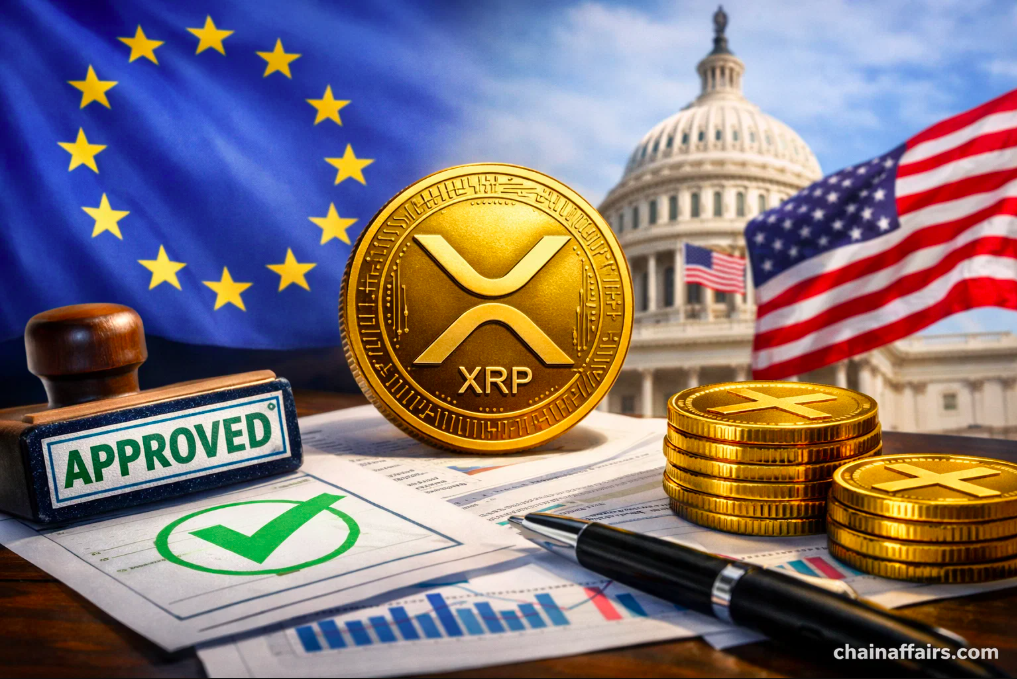
Ripple is advancing on two regulatory fronts at once. In Europe, the company has secured preliminary approval for an Electronic Money Institution (EMI) license in Luxembourg, strengthening its push toward full compliance with the EU’s Markets in Crypto-Assets (MiCA) framework. In the United States, shifting signals from regulators and lawmakers are reigniting expectations that XRP’s long-running legal uncertainty may finally be nearing resolution.
Taken together, the developments suggest Ripple’s regulatory strategy — long centered on early compliance and institutional readiness — is beginning to align with global policy momentum.
Luxembourg Approval Strengthens Ripple’s EU Position
Luxembourg’s financial regulator, the CSSF, has issued Ripple a “green light letter,” a formal step toward full EMI authorization. Once finalized, the license would allow Ripple to provide regulated digital payment services, including stablecoin-based transfers, across the European Union under passporting rules.
Luxembourg has become a strategic gateway for firms seeking EU-wide reach, offering a harmonized framework that fits neatly with MiCA’s upcoming rollout. Ripple is also pursuing a MiCA crypto asset service provider (CASP) license, which would enable it to operate across all EU member states under a single rulebook.
The approval follows closely on Ripple’s recent authorization in the UK, where its local entity received EMI and crypto asset permissions from the Financial Conduct Authority.
U.S. Tone Shift Revives XRP Regulatory Confidence
While Ripple builds in Europe, sentiment around XRP in the U.S. has shifted after remarks from SEC Chairman Paul Atkins. Commenting as Congress advances major crypto legislation, Atkins publicly backed efforts to clarify how regulatory authority should be split between the SEC and the CFTC — a key issue at the heart of XRP’s legal saga.
Market commentators interpreted the statement as a clear break from enforcement-led regulation. Some analysts, including prominent XRP watchers, have gone as far as calling XRP “a done deal” from a policy perspective, arguing that legislative clarity is now moving faster than litigation ever did.
Also Read: Why XRP Is Emerging as One of the Hottest Crypto Trades of 2026
Why Jurisdictional Clarity Matters for XRP
Proposed bills such as the Digital Asset Market Clarity Act aim to define asset categories and assign oversight more precisely. For XRP, this could resolve the gray area that has lingered since the SEC lawsuit began in 2020.
Clear classification would also open the door to broader institutional access. As Bloomberg Intelligence’s Eric Balchunas has noted, regulatory clarity is a prerequisite for products like spot ETFs, which could significantly expand XRP’s market reach.
The Bigger Picture
Ripple’s Luxembourg progress and the changing U.S. regulatory posture point in the same direction: crypto policy is moving from confrontation toward structured rulemaking. Whether prices react immediately is uncertain, but for XRP and Ripple, the regulatory path ahead looks more defined than it has in years.
Disclaimer: The information in this article is for general purposes only and does not constitute financial advice. The author’s views are personal and may not reflect the views of Chain Affairs. Before making any investment decisions, you should always conduct your own research. Chain Affairs is not responsible for any financial losses.

I’m your translator between the financial Old World and the new frontier of crypto. After a career demystifying economics and markets, I enjoy elucidating crypto – from investment risks to earth-shaking potential. Let’s explore!