|
Getting your Trinity Audio player ready...
|
- Solana offers higher returns but higher risk; Ethereum is lower risk with steadier rewards.
- Solana is easier to join; Ethereum requires 32 ETH per validator.
- Risk-takers may prefer Solana; conservative investors lean toward Ethereum.
Staking has evolved from a niche crypto mechanism into the backbone of digital asset infrastructure, enabling investors to earn yield while securing blockchain networks. As the crypto ecosystem matures, two dominant staking networks have emerged with distinctly different philosophies: Ethereum’s security-first approach and Solana’s performance-oriented model.
With institutional adoption accelerating and regulatory frameworks crystallizing, understanding the nuanced differences between ETH and SOL staking has become crucial for making informed investment decisions. This analysis examines both networks’ current state, upcoming upgrades, and strategic positioning in 2025’s evolving landscape.
Ethereum: The Secure Foundation of DeFi
Network Statistics and Scale
As of March 2025, over 1.04 million validators are securing Ethereum, up from 890,000 in late 2024. The total ETH staked stands at 30.2 million, representing 25% of the entire circulating supply. This massive validator set represents one of the most decentralized proof-of-stake networks in existence, with participation spanning individual home stakers to institutional operators.
Staking Mechanics and Requirements
Ethereum maintains its 32 ETH validator requirement (approximately $100,000+ at current prices), creating a natural barrier that has driven the liquid staking token (LST) ecosystem. Major providers include:
- Lido (stETH): Despite declining market share, still commands ~24-25% of staked ETH
- Rocket Pool (rETH): Focuses on decentralization with permissionless node operators
- Coinbase: In February 2025, Coinbase validators had an average uptime of 99.75%, significantly outperforming our 99% uptime target
Yield Profile and MEV Integration
Current ETH staking yields range from 3-5% APR, with several factors influencing returns:
- Base rewards: Determined by total ETH staked and network participation
- MEV opportunities: Validators can earn additional income through maximal extractable value
- Execution layer tips: Transaction fee rewards from block production
The relatively modest yields reflect Ethereum’s mature network effect and conservative monetary policy, prioritizing security over aggressive reward structures.
Upcoming Technical Developments
The Pectra upgrade, expected in April 2025, will raise the validator balance limit from 32 ETH to 2,048 ETH, reducing the need for node operators to run multiple validators. Additionally, EIP-7002 will enable smart contract-controlled validator withdrawals, potentially revolutionizing institutional staking infrastructure.
Institutional Integration Challenges
While Ethereum staking has achieved broad institutional adoption, a significant limitation remains: U.S. spot Ethereum ETFs, approved in July 2024, do not participate in staking. This means ETF investors gain only price exposure without validator rewards, creating a yield gap that may influence institutional allocation decisions.
Advantages:
- Battle-tested network with 2.5+ years of proof-of-stake operation
- Largest validator set ensuring maximum decentralization
- Comprehensive DeFi ecosystem integration
- Regulatory clarity in major jurisdictions
- Robust liquid staking infrastructure
Limitations:
- Lower yields compared to newer networks
- High capital requirements for direct validation
- Centralization risks around major LST providers
- ETF products don’t capture staking yield
- Exit queue delays during high withdrawal periods
Solana: High-Performance, High-Reward Staking
Network Architecture and Validator Economics
Solana operates approximately 1,000+ validators supporting transaction throughput up to 50,000 TPS with sub-second confirmation times. The delegated proof-of-stake model eliminates minimum staking requirements, making participation accessible to retail investors while maintaining network security through economic incentives.
Enhanced Yield Mechanisms
SOL staking currently delivers 5.5-7.5% APY through multiple revenue streams:
- Inflation rewards: Solana’s initial inflation rate is 8% annually, decreasing by 15% year-over-year, reaching a long-term fixed inflation rate of 1.5% annually
- Transaction fees: Revenue from Solana’s high-throughput activity
- MEV sharing: Advanced protocols like Jito distribute MEV profits to stakers
Liquid Staking Innovation
On January 18, 2025, Jito’s MEV-enabled staking reached an all-time high of 1.37 million unique tippers in a single day. These tippers are stakers who share in MEV rewards by delegating to Jito validators—earning passive income beyond standard staking yield.
This innovation represents a significant advancement in staking technology, allowing users to capture value typically reserved for sophisticated validators.
Reliability Concerns and Network Maturity
Solana’s pursuit of maximum performance has occasionally compromised stability. The network experienced its most recent significant outage in February 2024, with mainnet halting for approximately 5 hours. While these incidents have decreased in frequency, they highlight the inherent trade-offs between performance optimization and reliability.
Also Read: Solana (SOL) & Polygon (POL): Your 2025 Guide to Maximize DeFi Yields with Staking & Bridging
Ecosystem Growth Drivers
As the Solana ecosystem continues to expand, with over 400 billion transactions processed as of 2025, the network has become a hub for DeFi innovation, NFTs, and meme token trading. This activity generates substantial transaction fees that benefit stakers, creating a positive feedback loop for network growth.
Advantages:
- Superior staking yields with MEV integration
- No minimum staking requirements
- Innovative liquid staking products
- Rapidly growing ecosystem driving fee revenue
- High-performance infrastructure supporting diverse applications
Limitations:
- Historical network reliability issues
- Smaller validator set than Ethereum
- Higher token price volatility affecting real returns
- Less institutional adoption and regulatory clarity
- Technical complexity may deter conservative investors
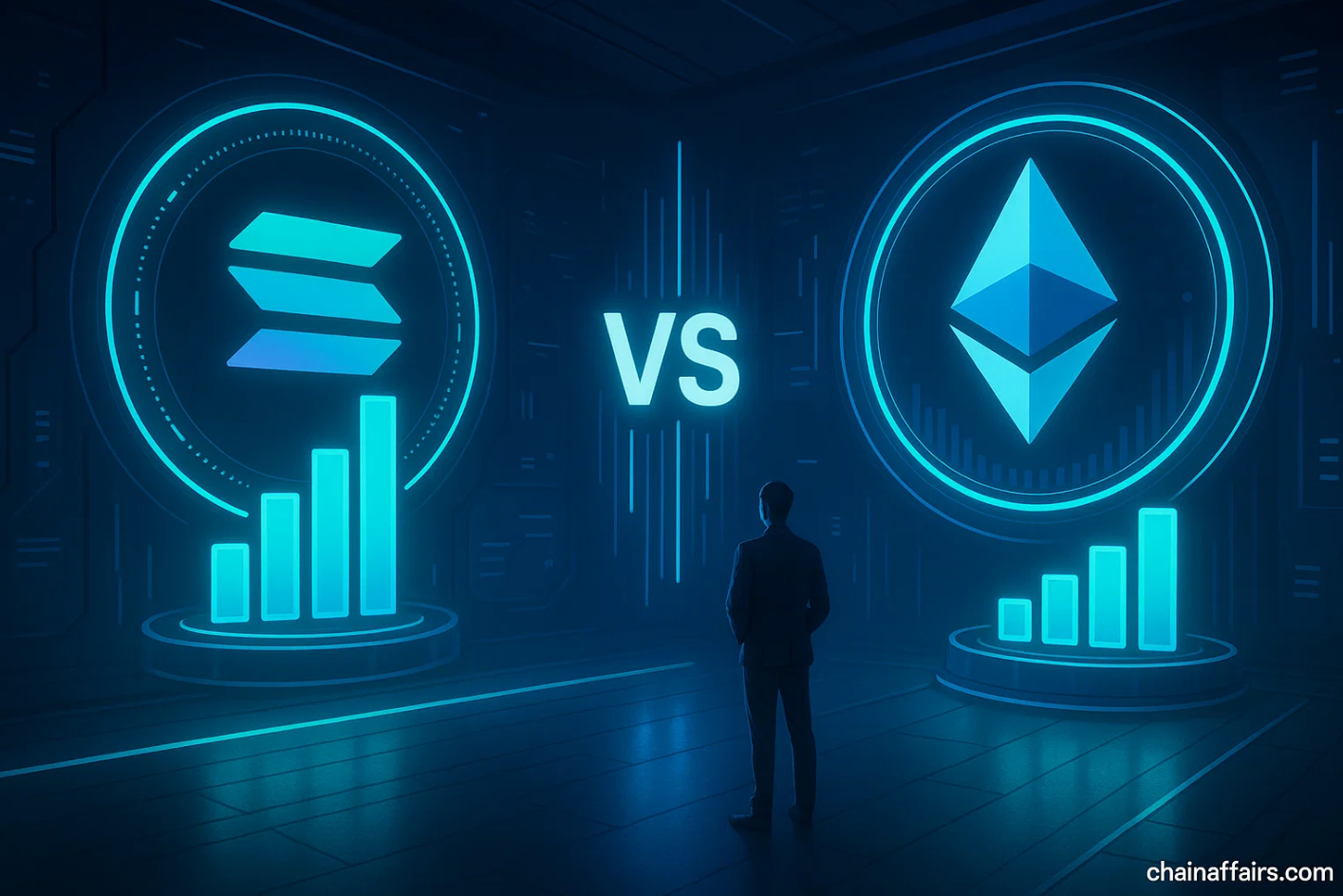
Comparative Analysis: Ethereum vs. Solana Staking 2025
| Feature | Ethereum (ETH) | Solana (SOL) |
|---|---|---|
| Validator Count | 1.04M+ | 1,000+ |
| Entry Barrier | 32 ETH (~$100k+) | No minimum |
| Yield Range | 3-5% APR | 5.5-7.5% APY |
| Network Uptime | 99.95%+ | ~99.8% (outage history) |
| Liquid Staking | stETH, rETH, cbETH | mSOL, JitoSOL, compassSOL |
| MEV Integration | Validator-level | Shared with delegators |
| Institutional Use | High (limited ETF integration) | Growing (DeFi-focused) |
| Upgrade Timeline | Pectra (April 2025) | Ongoing performance optimizations |
Strategic Investment Considerations
Risk-Adjusted Return Analysis
While Solana offers higher nominal yields, investors must consider:
- Volatility impact: SOL’s price volatility can erode yield advantages during market downturns
- Opportunity cost: ETH’s network effects and institutional adoption may provide superior long-term value
- Liquidity premiums: Ethereum’s deeper staking markets offer better exit options
Regulatory and Compliance Factors
Ethereum’s regulatory clarity in major jurisdictions makes it more suitable for institutional mandates, while Solana’s regulatory status remains evolving. This dynamic significantly influences large-scale adoption decisions.
Portfolio Integration Strategies
Conservative Approach: Weight toward Ethereum staking for stability, regulatory compliance, and proven network effects. Suitable for institutional investors and risk-averse individuals.
Yield-Focused Strategy: Emphasize Solana staking for higher returns and innovative features like MEV sharing. Appropriate for risk-tolerant investors seeking maximum yield.
Diversified Allocation: Split exposure between both networks to capture Ethereum’s stability and Solana’s growth potential while mitigating single-network risks.
Future Outlook: Evolution and Competition
Ethereum’s Path Forward
The Pectra upgrade represents a significant evolution in Ethereum’s staking infrastructure, potentially reducing operational complexity while maintaining decentralization. Smart contract-controlled withdrawals could unlock new institutional products and automated strategies.
Solana’s Maturation Journey
Continued network stability improvements and ecosystem growth position Solana as a legitimate alternative to Ethereum. The integration of advanced MEV-sharing mechanisms demonstrates technical innovation that may influence industry standards.
Competitive Dynamics
Both networks face competition from emerging Layer 1 blockchains offering different risk-reward profiles. However, their established ecosystems, developer communities, and institutional relationships create significant network effects that newer entrants must overcome.
Choosing Your Staking Strategy
The choice between Ethereum and Solana staking reflects broader investment philosophy and risk tolerance. Ethereum offers stability, regulatory clarity, and proven network effects at the cost of lower yields. Solana provides higher returns and cutting-edge features while accepting greater technical and operational risks.
As the staking landscape continues evolving, both networks demonstrate how proof-of-stake consensus can adapt to different market needs. Ethereum’s security-first approach establishes it as the foundation for institutional DeFi, while Solana’s performance optimization creates opportunities for yield-focused strategies.
Successful staking strategies in 2025 require understanding these fundamental differences and aligning network selection with investment objectives, risk tolerance, and regulatory requirements. The maturation of both ecosystems suggests that diversified exposure may capture the benefits of each approach while mitigating individual network risks.
The crypto markets are highly volatile and staking involves technical and financial risks. This analysis is for informational purposes and should not constitute investment advice. Always conduct your own research and consider consulting with financial professionals before making investment decisions.
Disclaimer: The information in this article is for general purposes only and does not constitute financial advice. The author’s views are personal and may not reflect the views of ChainAffairs. Before making any investment decisions, you should always conduct your own research. Chain Affairs is not responsible for any financial losses.

I’m your translator between the financial Old World and the new frontier of crypto. After a career demystifying economics and markets, I enjoy elucidating crypto – from investment risks to earth-shaking potential. Let’s explore!